
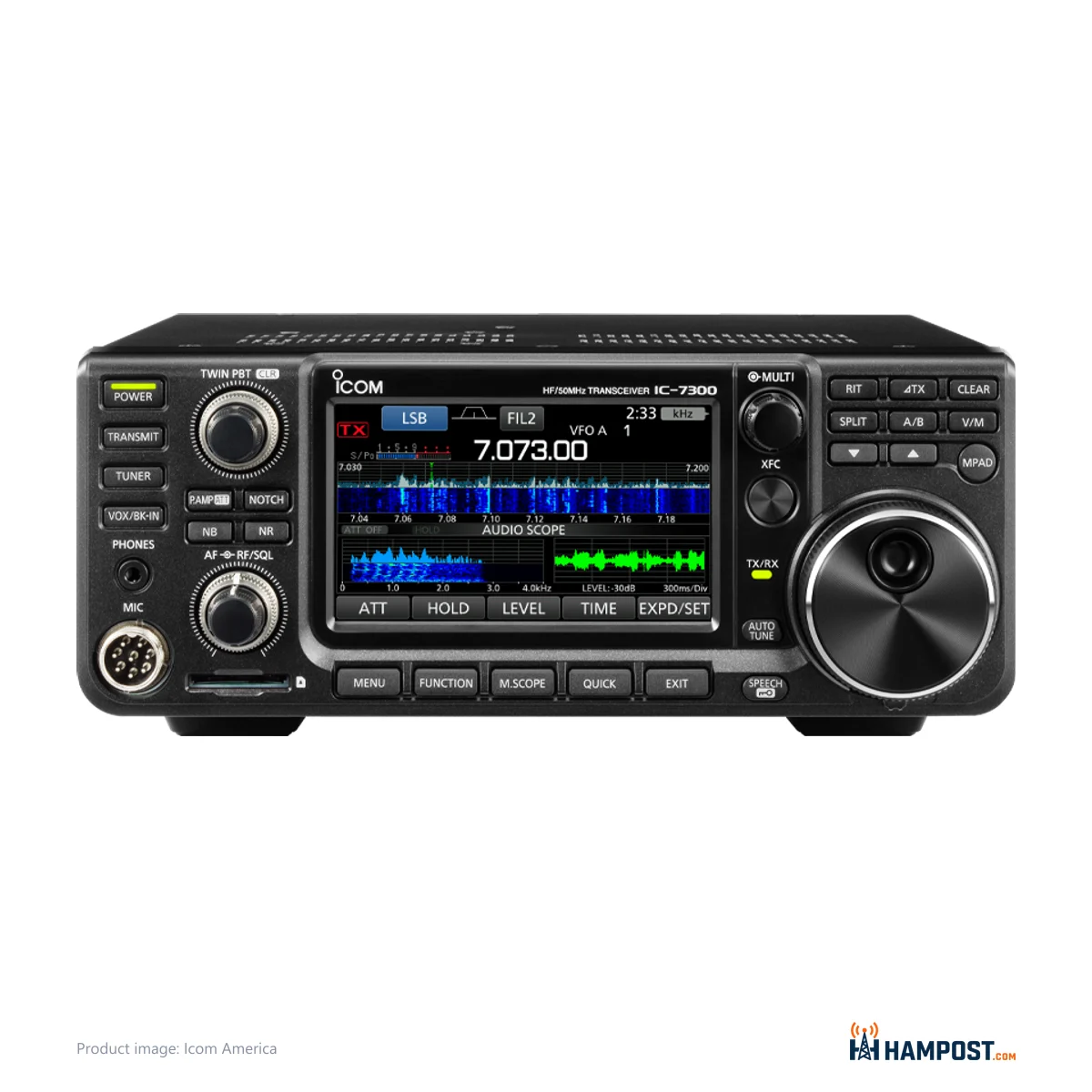
The IC-7300 landed in 2016. It is 2026, and it is still the radio I hand-recommend to every new General-class licensee who asks what HF rig to buy. That is a strange thing to say about a ten-year-old product in a hobby full of upgrades.
Street prices in this article were checked in March 2026 and move around; verify with a dealer such as HRO, DX Engineering, or GigaParts before you buy.
It is not because nothing newer exists. Yaesu shipped the FT-710, Icom has the IC-7610 and IC-905, Elecraft keeps building premium gear. It is because at street prices around $1,100, nothing else packs this much capability, this little friction, and this deep a support community into one box.
I have run mine almost daily for years. Here is the honest read, including the parts Icom would rather not put on the box.
Why It Mattered
Before the IC-7300, a transceiver with a real-time spectrum display started around $3,000. Direct-sampling SDR architecture at consumer prices simply did not exist in the amateur market.
Icom put a direct-sampling receiver and a colour touchscreen waterfall into an $1,100 box, and the hobby lost its composure. It became the best-selling HF transceiver Icom has ever made. Walk into almost any club station and you will find one on the desk.
The waterfall is the reason. You stop tuning blind. You see the band — every station, every mode, every noise source painted on screen. Tap the display, land on the signal. Watch a 20m opening develop in real time instead of guessing at it.
Once you have operated with a panadapter, going back feels like driving with the windscreen painted over.
How It Stacks Up in 2026
| Radio | Street price | Why you would pick it |
|---|---|---|
| Icom IC-7300 | ~$1,100 | Best all-round value; huge community; easiest digital setup |
| Yaesu FT-710 AESS | ~$1,100 | Newer front end, strong receiver specs, better audio out of the box |
| Xiegu G90 | ~$450 | 20W budget/portable work, built-in tuner |
| Icom IC-7610 | ~$3,500 | Dual receivers, SO2R, contest-grade phase noise |
| Elecraft K3S | ~$4,500 | Reference-class receiver for serious radiosport |
The FT-710 is the genuine head-to-head rival now, and on several receiver measurements it wins. What it does not have is ten years of forum threads, YouTube walkthroughs, and third-party accessories. When you are new and something goes sideways at 11pm, that ecosystem is worth real money. If I were buying fresh today I would put hands on both at a hamfest before deciding.
Five Things Every Owner Should Do
Update the firmware. Icom has shipped meaningful improvements since launch — faster scope refresh, added features, bug fixes. Check their site once a quarter. Plenty of second-hand units are still running 2017 code.
Watch your ALC on digital modes. This is the single most common FT8 mistake with this radio. If the ALC meter moves at all, you are overdriving. Back the audio down until it sits at zero. Overdriven FT8 is instantly obvious on everyone else's waterfall — you are splattering across 500 Hz and annoying the whole band.
Know what the internal tuner can do. The built-in automatic tuner matches 16.7 to 150 ohms, about 3:1 SWR, which covers a resonant dipole or vertical across a band but not a random wire. For bigger mismatches, add an external tuner such as Icom's AH-4 at the feedpoint or an LDG AT-600ProII in the shack.
Set the fan to low. Under settings, power. It will not overheat at duty cycles under about 50%. If you are running RTTY at full power for a contest weekend, put it back on auto.
Recalibrate the touchscreen when it drifts. If your taps start landing next to where you aimed, it is in the settings menu. Thirty seconds.
The Noise Tools, Ranked
The IC-7300 gives you four ways to fight noise, and they are not interchangeable. Reaching for the wrong one is why people complain the DSP "sounds bad".
Noise Blanker is for impulse noise — ignition rattle, electric fence ticks, anything with a sharp repeating edge. It is close to magic on that and actively harmful on everything else. Leave it off by default and reach for it only when you hear ticking.
Noise Reduction is for broadband hiss. It works, but the temptation is to run it high. Past roughly level 3 to 5 you get that hollow underwater artefact and weak signals start disappearing along with the noise. Low settings, always.
Notch — use the auto notch for a single carrier heterodyne and forget about it. It is one of the better implementations at any price.
Twin PBT (passband tuning) is the one almost nobody uses and the one that helps most. Squeezing the passband from either side to shoulder an adjacent signal out of the way beats every DSP trick on the list. Learn this before you learn anything else about the filters.
Honest opinion: the DSP here is good but not the reason to buy the radio. The filters and the PBT are. If you find yourself cranking noise reduction to make a band usable, the real problem is almost always local RFI at your own house, and no amount of receiver processing fixes that.
Getting the Scope Actually Useful
Most owners leave the spectrum scope on defaults and miss half of what it can do. Three settings change everything.
Centre versus Fixed mode. Centre keeps your frequency in the middle and the band slides past as you tune. Fixed pins the display to a chosen slice of the band and moves your marker instead. For hunting DX, Fixed on the segment you care about is far better — you watch a whole slice at once rather than dragging a window around. Most people never switch off Centre.
Scope span. A 500 kHz span looks impressive and shows almost nothing useful. Drop to 25 or 50 kHz for real resolution; you start resolving individual signals in a pileup rather than an orange smear.
Waterfall speed and reference level. If your waterfall is a wall of noise, reference level is set too low. Nudge it until the band floor goes dark and only real signals paint. This one adjustment does more for usability than any other on the radio.
Buying One Used
These come up constantly on QRZ and at hamfests, usually $700–900 depending on condition and accessories. It is a safe used buy, with caveats.
- Check the firmware version in the menu. Plenty of units are still on launch-era code. Not a dealbreaker — it updates over SD card — but it tells you how engaged the previous owner was.
- Press every corner of the touchscreen. Dead zones and heavy drift are the most common real fault on high-hours units.
- Ask what power supply it ran on. A radio fed from a cheap switching supply for five years has been living in RF hash.
- Listen to the fan on transmit. Bearing rumble means it has run hot for a long time.
- Confirm the original hand mic and SD card are included; replacements cost more than you would expect.
What almost never fails: the finals and the receiver front end. This is a robust design, and that is a large part of why the used market stays strong.
Who Should Buy It
New General licensees moving to HF: yes. Digital-mode operators: emphatically yes, the single-cable setup is still the least painful in the class. Anyone optimising capability per dollar for a home station: yes.
Serious contesters should look at the IC-7610 or a K3S. Portable and POTA operators are better served by an IC-705 or a G90 — the 7300 is too heavy and too power-hungry for a backpack. On a hard budget, a used IC-718 or FT-450D does real work for half the money.
Where it stops making sense is the operator who already knows they want to chase records. If you are certain you will be running assisted in the big contests within a year, the money spent here is money you will spend again. Buy once at the tier you are actually heading for.
Reader field notes — share yours
Log in to share your field notes and photos.