
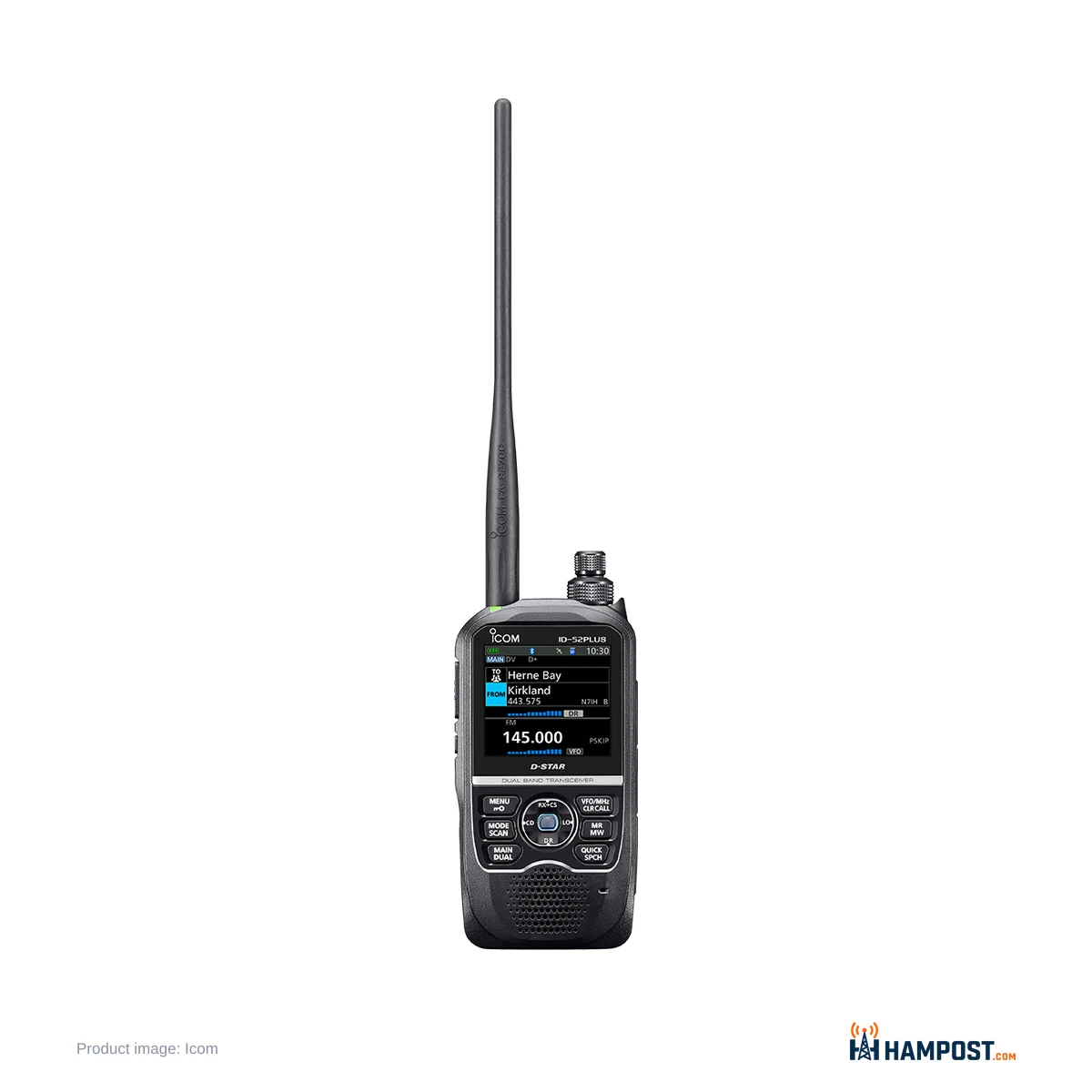
The ID-52A Plus is the D-STAR handheld that finds the repeater for you. Load the repeater list, let the GPS work out where you are, and DR mode hands you the nearest D-STAR and FM machines with a turn of the dial. That one feature, plus a big colour screen and a loud speaker, is why I would pick it over every other dual-band handheld for someone who travels with a radio.
It is also a $700-plus radio with no APRS modem, a headset jack that rejects most third-party plugs, and a phone-based Terminal mode that is harder to use than the box suggests. Street price runs around $700 to $750. Whether that is fair depends on how much of your operating is D-STAR.
What the Plus changes from the ID-52A
Icom kept the RF side, display, battery, GPS and audio of the ID-52A and changed three things. The micro-USB socket became USB-C, which charges the radio and handles programming, microSD access, CI-V and Terminal mode. A Bluetooth 5.3 module lets Terminal mode and Access Point mode run wirelessly to a phone running Icom's RS-MS3A (Android) or RS-MS3I (iOS, from firmware 1.10). And the radio can now run Terminal mode while it keeps working simplex or a repeater on RF.
Everything else carries over: 5 W on 2 m and 70 cm, FM and D-STAR DV, V/V, U/U and V/U dualwatch including two DV signals at once, GPS with D-PRS, a 2.3 inch 320 x 280 colour display, IPX7, and 1,000 memories plus space for 2,500 repeaters. If you are new to D-STAR and still choosing a mode, our comparison of D-STAR, System Fusion and DMR is the place to start. This radio does D-STAR and analog FM only.
DR mode and the GPS repeater search
This is the reason to buy it. The GPS gets a fix quickly, and Near Repeater search sorts the built-in repeater list by distance. Unlike some rivals, DR mode handles FM repeaters as well as D-STAR ones, so on the road you can scan the analog and digital machines around you without programming anything. On the Plus, once you pick the nearest repeater, the dial steps through the others nearby.
It only finds repeaters that are in the list, so the list is worth keeping current. Icom publishes updates, and firmware 1.10 added an option to import a new list without losing the order you set up. Load it from a microSD card.
D-STAR itself is easy here. DR mode includes reflector linking controls, and the radio decodes two DV signals at once. D-PRS sends your GPS position over D-STAR and gateways pass it to the APRS maps, but it is not packet APRS, a point I come back to below.
Receive, transmit and that 750 mW speaker
Icom rates the internal speaker at more than 750 mW, and it sounds it. Audio is loud and clear on FM and DV, and transmit audio gets good reports too.
The receiver is a strength beyond the ham bands. The A band covers 108 to 174 MHz and 225 to 479 MHz, with AM for VHF airband and UHF military airband, and there is a separate FM broadcast receiver you can listen to while dualwatching. Airband reception is good and broadcast FM sounds very good through that speaker. On 2 m and 70 cm Icom specifies less than 0.18 µV for 12 dB SINAD on FM and less than 0.2 µV at 1% BER on DV.
Output steps are 5 W, 2.5 W, 1 W, 0.5 W and 0.1 W. I would use the low steps for a close repeater or a hotspot on the desk and save the battery for when you need 5 W.
The band scope with waterfall works in center, fixed and fixed-scroll modes, and firmware 1.10 added a Memory Scope that shows activity across your memory channels. I see it as a nice extra rather than a reason to buy.
Battery life is the quiet advantage
The supplied BP-272 is rated by Icom at 7.25 hours in FM with a 1:1:8 duty cycle, power save on Auto (Short) and GPS off. The optional BP-307 is rated at 12 hours. In use, battery life is good, and next to a Kenwood TH-D75 the Icom lasts clearly longer on a charge.
The packs are shared with the ID-51, ID-31, ID-50 and the IC-705, so an existing Icom owner may already have spares. Charging is through USB-C with a USB adapter (USB PD is not supported), through the 10 to 16 V DC jack, or with the optional BC-202IP2 or BC-202IP3L desk chargers. Icom's ratings assume GPS off, so I would switch it off when you do not need D-PRS or the repeater search.
Screen, size and menus
The 2.3 inch colour display is large for a handheld and readable outdoors, and most operators like it a great deal. A smaller group finds the contrast weak, with blacks that look light grey rather than black, and to them it feels like a cheap part in an expensive radio. My view sits with the majority, but if you are coming from a phone-sharp display, look at one in person. You can switch the background between black and white, and one of the two may suit your eyes better.
Size is the other split. The ID-52 body is larger than the ID-51 it replaced, at 61.1 x 121.6 x 34.8 mm and 330 g with battery and antenna. Some ID-51 owners find it too bulky in the hand. Others prefer the larger body for the screen and speaker it allows. There is no numeric keypad, so frequencies go in with the joystick and dial.
The menus are easier to learn than most digital handhelds, and easier than the TH-D75. Entering a repeater by hand is quick, and the Quick menu puts the common settings one button away. Icom's CS-52PLUS software edits the radio's icf files from a microSD card or over USB-C, and RT Systems also sells a package for the Plus. The supplied USB-C cable works for programming.
Plan on a microSD card from day one. It holds backups of memories, settings and the repeater list, firmware updates, QSO recordings and GPS logs. Back up before every firmware update.
What goes wrong
Terminal mode is the biggest gap between the brochure and daily use. With RS-MS3A or RS-MS3I on the phone, the radio reaches the D-STAR network without a hotspot, but Icom's Terminal mode uses callsign routing to a Terminal-capable gateway or XLX server, not the REF and DCS reflector linking most hams expect. It needs a routable IPv4 address or port forwarding, and setup is fiddly, with connection failures that are hard to diagnose. Plenty of operators give up and use a hotspot instead. If wireless hotspot-free D-STAR is the feature you are paying for, I would not buy the radio for it.
The speaker-mic jack is deeply recessed. Icom accessories and plugs made for the ID-51 and ID-52 seat properly. Generic Kenwood-style plugs and many data cables do not seat fully, which brings odd audio routing or a PTT that will not key. Buy cables listed as compatible with the ID-50, ID-51 or ID-52, or use Icom's own.
There is no APRS TNC. D-PRS puts you on the map through a D-STAR gateway, which is fine for position reports, but packet APRS, messaging over FM APRS and Winlink need an external TNC. If APRS is central to your operating, our beginner's guide to APRS tracking explains what you would be missing.
The last one is price. At around $700 to $750 it is among the most expensive dual-band handhelds, and operators split on whether it is worth it. Those who use D-STAR, the GPS repeater search and the airband receiver every week tend to think it is. Those who mostly work FM repeaters do not.
How it compares
RadioWhy you'd pick it Icom ID-52A PlusD-STAR with GPS repeater search, a large colour screen, loud audio and long battery life Kenwood TH-D75D-STAR plus full APRS with a KISS TNC, 1.25 m transmit and phone-based reflector access (our TH-D75 verdict) Icom ID-50ASame D-STAR core and USB-C at a lower cost, with a monochrome screen and no Bluetooth Yaesu FT5DRSystem Fusion instead of D-STAR, with dual receive and APRS AnyTone AT-D878UVII PlusDMR with APRS and GPS at a much lower cost (AT-D878UVII Plus review)For the wider field, our handheld buyer's guide covers radios at every price. If the choice is between Icom and Kenwood, the TH-D75 spec page lays out the Kenwood's numbers next to this one.
Setting one up the way I would
- Set MY call sign first, then update the repeater list from a microSD card.
- Leave GPS on and use DR mode with Near Repeater for anything away from home.
- For a hotspot, add it to the repeater list with TYPE set to DV Simplex. On a plain memory channel, use duplex with a 0.000 MHz offset instead. Our Raspberry Pi hotspot build guide covers the hotspot side.
- Try the 0.1 W S-Low power step on close repeaters and the hotspot.
- Buy a BP-307, or reuse BP-272 and BP-307 packs from an ID-51, ID-31 or IC-705.
- Program long channel lists with CS-52PLUS or RT Systems, and keep a backup on the microSD card.
- Only buy speaker mics and data cables listed for the ID-5x jack.
- Pair a Bluetooth headset if you want hands-free. Pairing is simple.
Who should buy it
- D-STAR operators who want the best-equipped handheld for the mode.
- Travellers who want GPS to find FM and D-STAR repeaters without programming them.
- Pilots and listeners who will use VHF and UHF airband and broadcast FM.
- Owners of ID-51, ID-31 or IC-705 batteries and accessories.
Skip it if APRS with a real TNC matters to you, if hotspot-free D-STAR through a phone is the main attraction, if you operate mostly FM, or if a cheaper ID-50A covers what you need.
Bottom line
The ID-52A Plus is the best D-STAR handheld for operators who travel, with GPS repeater search, a large screen, loud audio and battery life the TH-D75 cannot match. Terminal mode, the fussy accessory jack, the lack of APRS and the price hold it back, so buy it for D-STAR and DR mode, not for the Bluetooth features.
Reader field notes — share yours
Log in to share your field notes and photos.