
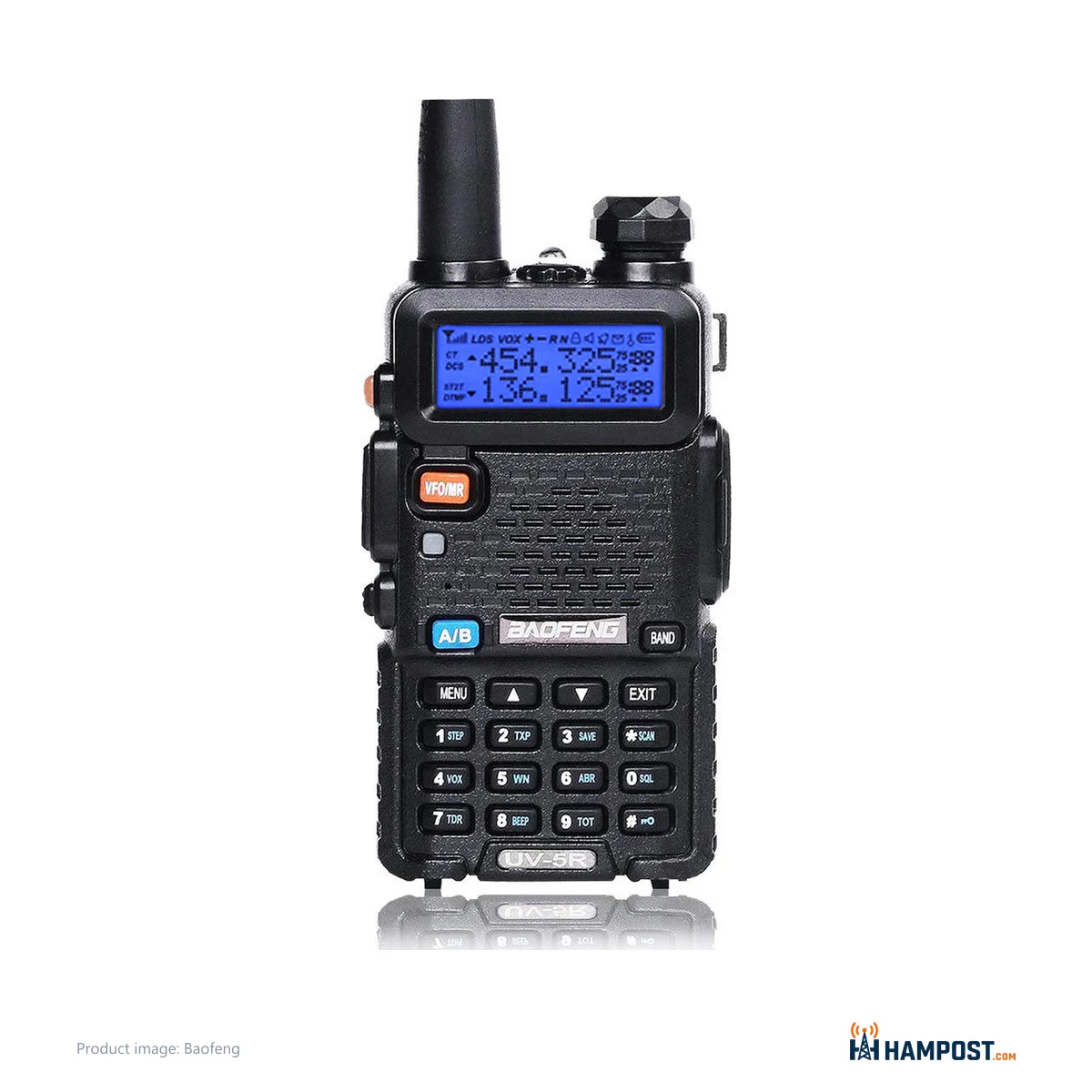
Twenty-five dollars. That is what puts a new ham on the local repeater the day the license comes through, and for a lot of us the Baofeng UV-5R was that first radio. It still sits on the charger in our shack as the loaner, the go-bag spare and the one I hand to visitors who want to try a repeater without touching anything expensive.
It earns that place. It also has real limits, and some of them are not about convenience but about how clean the signal is and which frequencies it will happily transmit on. Both halves matter, so this review gives you both.
A cheap radio you don't have to baby
Day to day, the UV-5R is a simple dual-band FM handheld: 5 W on 2 m and 70 cm, 128 memories, CTCSS and DCS, VOX, DTMF, a timeout timer and an LED flashlight in the top. It receives FM broadcast too, which gets more use than I expected on a long net.
What I like most is that I never worry about it. Mine has been dropped, left in cold cars and tossed in bags. The worst wear I've seen is a loose volume knob. At a street price around $25 to $40, losing it would sting less than losing a good antenna.
The kit helps the value case. Mine came with a drop-in charger, an earpiece mic and a spare antenna, which is more than some name-brand radios include. That is a real starter package, not a bare radio.
It is still a bargain radio, not a primary one. I'd call it a starter and a spare. If you get serious about VHF and UHF, you will outgrow it, and I would not make it the only radio you count on in an emergency.
Receive: fine in the country, fragile in the city
In a quiet RF environment, receive is adequate for repeaters and simplex, and sometimes better than that. With a decent antenna I hit local repeaters from indoors and work simplex across town with clean audio reports.
Move it somewhere busy and things change. Operators disagree sharply here. One side says the receiver is perfectly good for repeaters and scanning and the complaints are brand snobbery. The other finds it close to unusable in moderate RF noise: inside a modern car, near WiFi and LED lighting, or close to a broadcast or pager site, with the 70 cm side desensing and intermod from a strong FM station.
My take sits between them. Out of town and at home it works. In a car or downtown, I've heard it fall apart where a name-brand handheld kept copying. The front-end filtering is thin, and that is the price of the price.
Whether later production fixed this is also disputed. One view holds that newer batches cured the early intermod, selectivity and firmware problems. The stronger case against it is that overload still turns up on radios bought in recent years. I have no lab numbers for selectivity or intermod, so treat my verdict as what I heard, not a measurement.
Transmit, spurs and the legal fine print
Transmit audio is fine for repeater work. Reports come back clear and readable, and 5 W from a handheld is 5 W.
The signal quality is the part I'm blunt about. Bench tests of older production put spurious emissions above FCC limits, and harmonic suppression varies by batch, from short of the 40 dB Part 97 asks for to just inside it. Newer production is said to have better filtering, but I would not assume any given radio is clean. If clean spectrum matters to you, and it should, test yours or put a filter on it.
The certification is the other problem, and I can't vouch for the lab paperwork myself. My understanding is that the UV-5R is not a Part 97 type-accepted amateur radio, and the certification it has been tied to is Part 90. What I can tell you for certain is that it will transmit well outside the ham bands, including FRS, GMRS and commercial frequencies. Your license covers amateur frequencies only. Keep it there.
Programming: get the cable, skip the keypad
Keypad programming is awkward. Setting up a dozen repeaters with offsets and tones from the front panel is tedious work, so most of the time I use CHIRP and a cable. I gave up on the vendor software quickly because it is poor.
Operators disagree on how bad the keypad really is. One side calls it near impossible without CHIRP. The other says it is easy enough with a short checklist and the complaints are overblown. I'd say it is learnable, worth practicing for the field, and slower than CHIRP every time.
The cable is the usual failure point. A 'no response from radio' error in CHIRP almost always means a counterfeit-chip cable that Windows drivers refuse, or a plug that isn't fully seated in the 2-pin Kenwood-style jack. A cable with a genuine FTDI chip fixed it for me. Also ignore the firmware text on the power-on screen, because most radios since BFB299 still report BFB297. Read the real version in CHIRP.
Battery and charging
Battery life is a good point. The pack is rated 1500 mAh at 7.4 V on the maker's sheet, with some later packs at 1800 mAh, and on a day of repeater listening with a little talking it outlasts radios that cost far more. I can't give you a clean hours figure that matches the maker spec, so I won't.
The drop-in cradle can be fussy. It may not charge unless the battery is seated before you plug the cradle in, so do it in that order. Keep any external supply to 10 V or less, because the charger can overheat above that.
Where it breaks
Build quality is the other split. Operators disagree: one side calls it sturdy, drop-proof and good for years, the other says it feels less solid than name-brand radios and varies from lot to lot. I'm closer to the first camp, but I'd never buy one without testing it straight away.
The failures to check for in the first weeks:
- Dead on arrival, receive-only, or no modulation on transmit.
- Volume pot going scratchy or dying, and lost transmit audio.
- Display blanking in strong heat or cold.
- Keypad legends rubbing off, and the volume knob coming loose.
- Lock-ups, including on transmit.
- A DCS-on-receive bug with some Motorola gear, and firmware differences between batches.
- Counterfeit radios and counterfeit accessories, especially antennas.
Buy from an authorised dealer and test everything early, while a replacement is easy. A dodgy wall wart or charger is a dealer swap, not a reason to give up on the radio.
Years later, and what I changed
The long-term picture is better than the failure list suggests. Past the two-year mark, mine just keeps working. The battery is the part that wears first and gets replaced, and the volume control is the weak spot to watch as it ages.
The stock antenna went first. It is poorly matched and weak, and a Nagoya NA-771 made more difference than any setting in the menu. A Diamond RH771 or MFJ-1717S does the same job. Watch for fake Nagoyas, which are common. It's the cheapest upgrade with the biggest return.
I also use the dual watch and split memories more than I thought I would. Split memories make crossband and satellite work possible on a basic radio, and DTMF covers Echolink access.
The UV-5R against its neighbours
| Radio | Street price | Why you'd pick it |
|---|---|---|
| Baofeng UV-5R | Around $25-40 | The cheapest way onto 2 m and 70 cm, with a huge accessory and CHIRP base |
| Baofeng BF-F8HP / UV-5R+ / UV-5RA | UV-5R+ about $40 | The maker's successor and near-clones; same accessories and CHIRP support |
| Baofeng UV-82 | Baofeng money | Same family, dual PTT, 8 W variants |
| Quansheng UV-K5 | Budget | A newer cheap HT with a better receiver and alternative firmware |
| Yaesu / Kenwood name-brand HT (Vertex-150, THF6) | Well above a Baofeng | Better receive in noisy RF, proper certification, more consistent build |
How I set up a new one
- Read the radio with CHIRP and save the factory image before changing anything.
- Use a programming cable with a genuine FTDI chip. Seat the plug fully and take the antenna off while programming.
- Check the real firmware version in CHIRP and ignore the power-on text.
- Replace the stock antenna with a Nagoya, Diamond RH771 or MFJ-1717S, and make sure it's genuine.
- If the antenna connector's retaining nut works loose, put removable thread locker on it.
- Practice keypad programming at home so you can add a frequency in the field without a laptop.
Who should buy it
- A new ham on a tight budget who wants a first handheld for local repeaters.
- Anyone building an ARES, emergency or go-bag kit who wants a cheap spare.
- Operators in quiet, rural RF environments working repeaters and simplex.
- Tinkerers who want to learn CHIRP programming on a radio they won't mind breaking.
Skip it if you live and drive in heavy RF, if you want Part 97 type-accepted gear with clean spectrum and no added filter, or if you want to set up everything from the keypad. And if the plan is FRS, GMRS or business channels, this is the wrong radio: it reaches them but isn't certified for them.
Bottom line
The UV-5R is a tough, cheap, genuinely useful starter and backup handheld that gets a new ham on the air for about $25. Its receiver struggles in RF noise, its spurious emissions vary by batch, and it is not certified as amateur gear, so fit a better antenna, program it with CHIRP and keep it on ham frequencies. Treat it as the first radio you own, not the last.
Reader field notes — share yours
Log in to share your field notes and photos.