
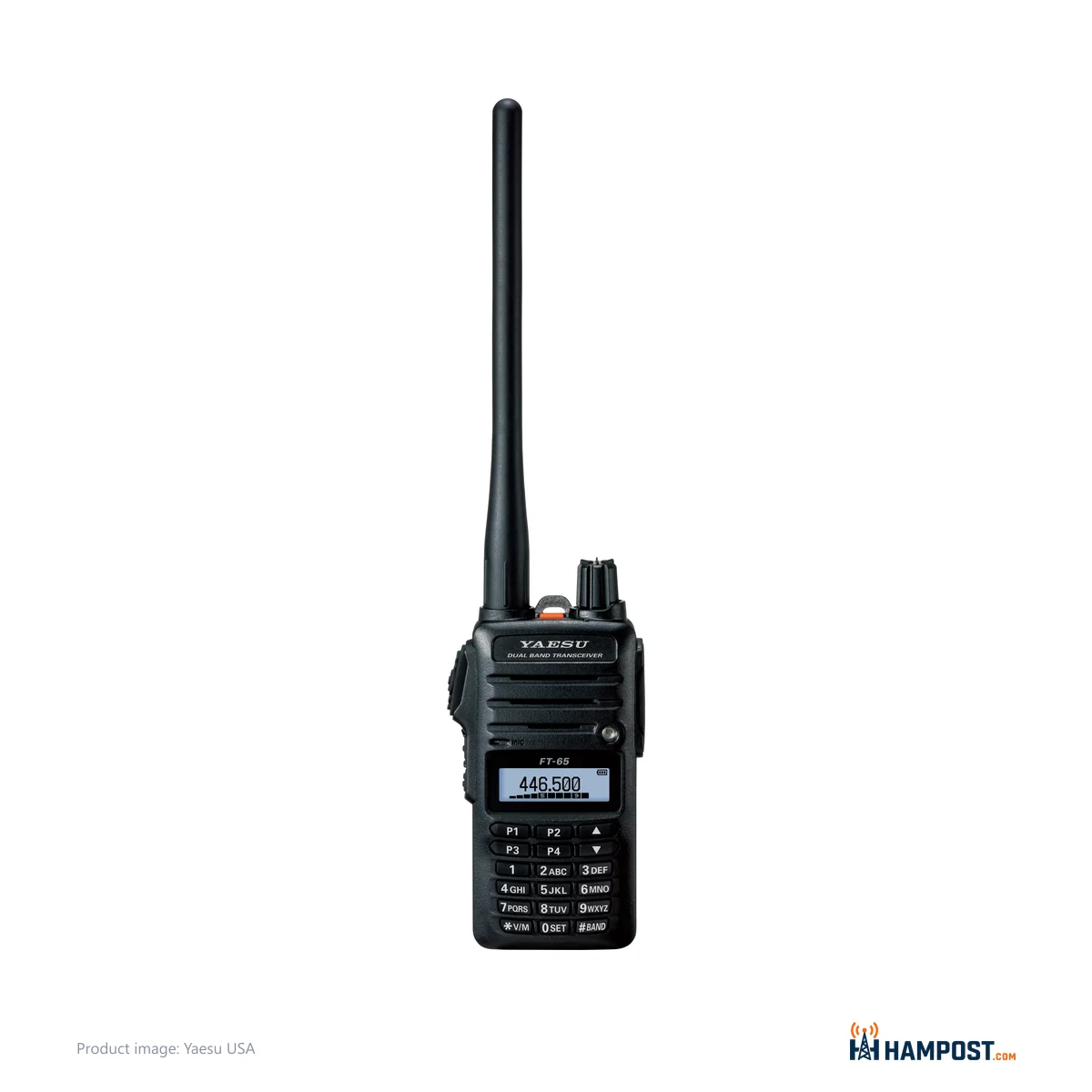
Park next to a cell tower with a Baofeng and the squelch never quite settles. Do the same with the FT-65R and the speaker stays silent until somebody keys up. That one difference is most of the reason this little Yaesu rides on my belt.
It is a plain 2 m / 70 cm FM handheld at 5 W. No digital, no GPS, no APRS. It costs a bit more than the Chinese radios it gets compared with, at a street price around $90 to $130, and for that you get a better front end, a tougher case, a menu that makes sense and a 3-year warranty with service in the US.
It has flaws. The stock antenna is poor, quality control is not perfect, and there is no squelch knob. Still, as the first name-brand radio after a Baofeng, or instead of one, it is the handheld I point new hams toward most often.
Carrying it every day
The FT-65R feels like a tool. The plastic is thick, the volume knob is firm and the PTT has a clean, positive click. The case shrugs off drops. It carries IP54 and MIL-810 C/D/E ratings, which means rain and dust, not a swim.
The layout is simple: one knob on top, a full keypad, and four programmable Quick Recall keys on the front. New hams like that. I like it less. With no second knob there is no quick squelch and no VFO knob, so squelch lives in the menu. Once it is set you rarely touch it, but on a weak simplex signal I miss opening it by feel.
The feel is not perfect. The side and front buttons can be mushy, and the case can sound a little hollow when you tap it. The shape and the reverse SMA jack look a lot like a Baofeng, which has fed the idea that this is a rebadged Chinese radio. More on that further down.
The LED flashlight on top is small. It gets used anyway.
Receive and transmit: where the money goes
The receiver is the reason to buy this over a $25 handheld. Around cell sites and on crowded summits the FT-65R stays quiet while a Baofeng beside it fills with noise. For SOTA, where the best summits often have towers on them, that alone justifies the price.
It is not bulletproof, though. In a truly heavy RF spot I would rather carry a radio with a tougher receiver, and the FT-70DR with its superhet design is the obvious step up in the same family. Tone squelch on your regular channels keeps the speaker quiet when the band gets busy.
Transmit is clean. Power steps are 5, 2.5 and 0.5 W, and I run the lowest setting that makes the local machine, which stretches the battery. Audio reports come back clear. The transmitted signal is cleaner on the spectrum than the cheap radios in its class, and that matters if you share a site with other gear.
A loud speaker, with one caveat
The 1 W speaker is loud and clear. Next to a Baofeng UV-9R Plus the Yaesu is easier to understand, and transmit audio holds up just as well. Not bad for a basic analog radio.
If a wide signal sounds distorted, check the mode before blaming the speaker. Switching that channel from NFM to WFM cleans it up.
The caveat is the speaker itself. Speaker faults are on this radio's known list: audio that turns tinny or scratchy after the first few uses, or a constant 4 kHz tone under everything. Spend the first week listening on a few different channels at a few volume levels. If the audio goes bad, try a power cycle, and if that does not clear it, use the return window or the warranty rather than living with it.
Battery: days, not hours
The included SBR-25LI is a 1950 mAh Li-ion pack, rated by Yaesu at over 9 hours. In real use, with half an hour to an hour of listening a day, it sits for two to three weeks between charges. Casual use gets me several days of carry without thinking about it.
The optional SBR-26LI at 2500 mAh is rated at over 11.5 hours and gets me through a couple of full days. A rapid charger comes in the box and takes about 3.5 hours. FT-60R packs will not fit, so old Yaesu batteries are no help here.
One oddity: the manual says to slide the pack down to remove it. What actually works is lifting the lower part of the pack up and away.
Programming from the keypad, and the three menus that matter
This is the part Yaesu got right. The menu is alphabetical, alpha tags go in from the keypad and memory banks keep things tidy. I can load a dozen repeaters in a few minutes without a computer, and automatic repeater shift sets the offset for me.
The manual is the weak spot. It never spells out that repeater work needs three settings, so it is easy to set the tone and wonder why the machine ignores you. Here they are: Menu 8 for the CTCSS tone, Menu 24 to turn Automatic Repeater Shift on, and Menu 29 to set SQL Type to T-Tone.
For a full channel list, use software. Yaesu's free programmer, RT Systems and CHIRP all handle it with the SCU-35 cable. CHIRP is my default, and it is the one to reach for if the Yaesu program will not see the radio. The SCU-36 cable clones one FT-65R to another, which is handy when an ARES group sets up several radios at once.
What goes wrong, and what to check early
The track record is good, not spotless. Quality control misses show up often enough that I treat the first couple of weeks as a test period:
- Power it on the day it arrives and confirm the display and keypad work. A dead or blank radio goes straight back.
- Program a few CTCSS and DCS channels and run a memory scan. Scan that will not stop on tone channels, and DCS that does not decode in memory scan, are known faults with no real fix. Turning off DCS on receive is the workaround.
- Listen to the speaker at several volume levels, as described above.
This is why the warranty matters. Three years with US service is a real feature on a radio in this bracket, and it covers board-level repairs, not just a swap of the antenna.
Past the first year, a good unit tends to stay good. Mine remains a solid basic daily HT, the battery still lasts days, and the case has survived drops without complaint.
Real Yaesu or a Baofeng in a Yaesu case?
Operators disagree on this, and the doubters have a case. The FT-65R is built in China, it shares the Baofeng shape and reverse SMA jack, it can feel hollow in the hand, and the QC list above is real. If you expected a Japanese-built Yaesu, that stings.
I sit on the other side. The things you can hear and measure favor the Yaesu: cleaner transmit spectrum, better filtering, a quieter receiver near strong signals, plus Yaesu's menu and support. A rebadged Baofeng would not behave the way this one does next to a tower. For me the difference shows up every time I park near one.
What I changed: antenna first
The stock rubber duck is the weakest part of the package. Its match across 2 m is poor, and it holds the radio back on marginal repeaters. The radio uses reverse SMA like a Baofeng, so the usual upgrades fit: a Nagoya NA-771 or NA-701, or a Diamond SRJ77CA. Nothing in the menu made as much difference to range as that swap.
The accessory jack is Kenwood-style 2-pin, so the common Kenwood-pattern speaker mics fit, and a 3.5 mm earphone works too. That makes it easy to share accessories with radios you already own.
How it compares
| Radio | Why you'd pick it |
|---|---|
| Yaesu FT-65R | Quieter receiver than the cheap radios, tough case, easy keypad menu, 3-year warranty |
| Baofeng UV-5R / UV-82 / UV-9R | Same size and price class, same antenna jack; weaker receiver, build and support |
| Yaesu FT-70DR | Superhet receiver, tougher build and C4FM digital if you want more than analog FM |
| Yaesu FT-60R | Older analog HT; bigger and heavier than the FT-65R, and the batteries are not interchangeable |
Setting one up the way I do
- Replace the stock antenna with a Nagoya NA-771 or NA-701, or a Diamond SRJ77CA.
- For repeaters, set Menu 8 CTCSS tone, Menu 24 Automatic Repeater Shift ON and Menu 29 SQL Type to T-Tone.
- Load the bulk of your channels with CHIRP (or Yaesu's free software, or RT Systems) and the SCU-35 cable. If the Yaesu program will not connect, try CHIRP.
- If receive audio on a wide signal sounds distorted, switch that channel to WFM.
- To pull the battery, lift the lower part of the pack up rather than sliding it down.
- Add the SBR-26LI 2500 mAh pack if you need longer runtime, and a Kenwood-style 2-pin speaker mic for belt carry.
Who should buy it
- New hams who want a simple analog radio for the local repeaters.
- Anyone moving up from a Baofeng on a budget.
- ARES, SOTA and daily-carry backup duty.
- Operators who program in the field from the keypad, with no PC along.
Who should skip it
- Anyone who wants digital modes, GPS or APRS. Look at the FT-70DR or higher.
- People working in heavy RF environments who need a receiver that never overloads.
- Anyone who wants a squelch knob or a VFO knob.
- Buyers who will not swap the stock antenna but still want maximum range.
Bottom line
The FT-65R is the radio to buy when a Baofeng's receiver starts to annoy you: quieter near strong signals, sturdier in the hand, easy to program from the keypad and backed by a 3-year warranty. Budget for a better antenna on day one and check the speaker and scan in the first week, and it will make a dependable everyday handheld.
Reader field notes — share yours
Log in to share your field notes and photos.