
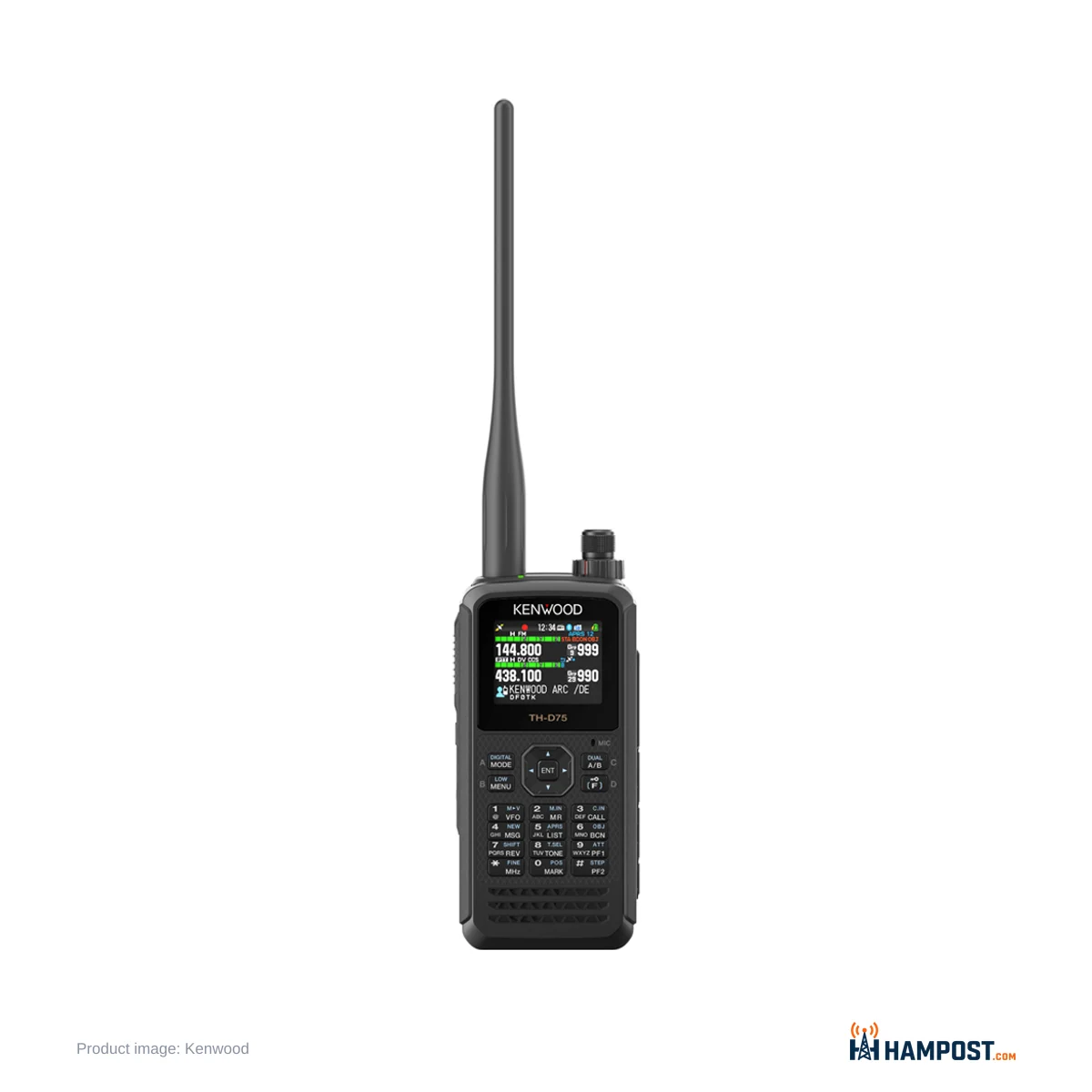
Plan the day around the battery. The TH-D75 packs more into one handheld than anything else I would carry: three bands, D-STAR on both receivers, APRS with a built-in digipeater, GPS, a KISS TNC and receive from 100 kHz to 524 MHz. All of it runs from a 1820 mAh pack, and with GPS, dual watch and beaconing switched on, that pack runs out long before the day does.
Everything else is why people pay for it. Transmit audio is full and clean, the speaker is loud, the APRS screens are the best on any HT I know of, and the menu system makes sense once you stop fighting it.
It is also expensive, with a street price around $600 to $750, and Bluetooth is hit and miss. If you want one radio for APRS, D-STAR and 1.25 m, nothing else covers all three. If you want a reliable FM handheld, you are paying for features you will not use.
The battery is the first thing to sort out
Kenwood rates the supplied KNB-75LA pack (7.4 V, 1820 mAh) at about 6 hours on High and 15 hours on EL power, with a 6:6:48 duty cycle and GPS and Bluetooth turned off. Nobody runs a TH-D75 that way. Turn on GPS, dual receive and an APRS beacon and the pack drains fast. A spare battery belongs in the bag from day one.
Charging is the second annoyance. There is no drop-in charger in the box, only a wall adapter for the DC jack, and both that adapter and USB-C charge slowly. The desk charger is an extra purchase. Menu 923 lets the radio charge while it is switched on and receiving, which suits desk and vehicle use. The manual warns against transmitting while charging, and I follow that.
High-capacity aftermarket packs fix the runtime problem, and some carry their own USB-C port. With one of those fitted, runtime stops being something you plan around.
Firmware 1.03 made the battery gauge more accurate, so update before you judge the pack by its meter.
Audio that earns the price
This is a Kenwood, and it sounds like one. Transmit audio gets good reports on FM and D-STAR straight out of the box, with no tweaking. The speaker is clearly louder and fuller than the TH-D74's and stays clean at high volume, which most handhelds cannot manage.
Both transmit and receive have a programmable equalizer, so you can tune the sound to your voice or to a speaker mic. I would leave the transmit EQ alone until you get a report that says otherwise. The default is already good.
APRS, GPS and packet: where it leads
APRS is the reason many people buy this radio, and it delivers. The station list holds 100 stations with distance, bearing, heading and speed. Weather stations show in color. Messaging works from templates or the keypad, and SmartBeaconing and proportional pathing are built in. The standalone digipeater is new on the D75 and is useful for temporary relays in poor terrain.
The GPS gets a fix in about 40 seconds from cold and shows your Maidenhead grid square, altitude and up to 100 named waypoints. Track logging writes to the microSD card. If you care about privacy, the position ambiguity setting (Menu 402) blurs the location in your beacons. For a primer on the mode itself, read our APRS beginner's guide.
The KISS TNC opens up packet and Winlink over USB-C or Bluetooth. Both work. For anything longer than a quick check, the USB-C cable is the reliable path. Bluetooth data sessions drop often enough to be a nuisance.
D-STAR: DR mode, hotspots and terminal mode
The D75 can receive D-STAR on both bands at once, which the D74 could not, and it adds Reflector Terminal mode. With BlueDV on an Android phone or a Windows PC, over Bluetooth or USB-C, the radio reaches reflectors through the internet with no hotspot at all. That alone justifies the upgrade for a travelling D-STAR user.
The D-STAR setup is where most new owners get stuck, and the manual does not help much. DV mode is for simplex. DR mode is for repeaters and hotspots. A simplex hotspot needs DR mode with a zero offset, entered in the hotspot list under Menu 230. Put your callsign in Menu 610 before anything else. With those three things right, it works the first time. Get one wrong and you hear traffic but nobody hears you.
If you are still choosing a digital mode, the digital voice comparison lays out D-STAR against Fusion and DMR. The D75 does D-STAR only. It does not do DMR or C4FM.
Menus, memories and programming
The menu is three levels deep, and every item also has a number you can type directly. Once you know that backlight is in Configuration and Display, or that Menu 923 is charging, it goes quickly. Operators split on it. One camp calls it impenetrable and the manual incomplete. The other finds it better organized than any HT menu they have used. My view: learn the basics from the keypad, then do big memory lists on a PC.
The memory system is a strength. There are 1000 channels in 30 groups, and both channels and groups take 16-character names. Scanning one named group, such as the repeaters of a city you visit, is simple, and the full name on screen means no printed cheat sheet.
For programming, Kenwood's MCP-D75 is free and works over USB-C. Some find it perfectly adequate. Others find it clumsy and buy RT Systems software, which is the polished option. CHIRP supports the radio too. Whatever you use, save a copy of the radio before a firmware update, because the update ends with a full reset that erases memories and settings.
Bluetooth is the weak spot
The radio uses Bluetooth 3.0 with headset and serial profiles. In practice pairing is unreliable. Many headsets that work with a phone will not pair at all, and connections to Windows PCs drop or need deleting and re-pairing after updates. It is classic Bluetooth, not Bluetooth LE, so iPhones and iPads cannot talk to the TNC directly.
When something stops connecting, delete the pairing on both ends and pair again. That fixes most cases. If you need a wireless headset for serious use, test it with your own radio before you rely on it.
Build, screen and what it will not do
The case is rated IP54/55 and feels solid in the hand. The color transflective screen reads well in direct sun. It is small, though, and an ID-52A Plus shows more on its larger display.
Some things are missing. There is no full-duplex operation, so FM satellites mean transmitting on one band and listening on the other without hearing yourself. There is no cross-band repeater and no flashlight. Band B receives from 100 kHz up, with SSB and CW filters. I could not confirm that it hears HF well enough to buy it for that, so treat HF listening as a bonus. SSB receive earns its keep on 2 m and 70 cm, especially as a satellite downlink receiver.
Then there is the price. Operators who use APRS, D-STAR and 220 MHz every week call it worth every cent. Those who mostly talk on FM repeaters find it hard to justify.
How it compares
RadioWhy you'd pick it Kenwood TH-D75APRS with TNC and digipeater, D-STAR on both bands, 2 m / 1.25 m / 70 cm, GPS Icom ID-52A PlusLarger screen and D-STAR, but no 1.25 m and no built-in APRS TNC Yaesu FT5DRC4FM instead of D-STAR, with a well-liked APRS setup and GPS Icom ID-50AAbout half the price, D-STAR and GPS, but no APRS, no 1.25 m and no Bluetooth AnyTone AT-D878UVII PlusDMR instead of D-STAR, at a fraction of the cost (our review)If you only need FM, a tough analog radio like the Yaesu FT-60R costs a fraction of the D75 and lasts as long.
Setting one up the way I would
- Update to the current firmware first. The update resets the radio, so do it before you program anything.
- Enter your callsign in Menu 610.
- Load repeaters and groups on a PC with MCP-D75 or RT Systems, and save a backup file.
- Buy a second battery or a high-capacity pack before your first long day out.
- On the desk or in the car, turn on Menu 923 so it charges while you listen. Avoid transmitting while it charges.
- For a hotspot, use DR mode, zero offset and an entry in the hotspot list (Menu 230).
- Set SmartBeaconing for mobile APRS, and Menu 402 position ambiguity if you want privacy.
- Use the USB-C cable for packet, Winlink and long data sessions. Keep Bluetooth for casual use.
Who should buy it
- APRS operators who want the full feature set in a handheld, including a digipeater and a usable TNC.
- D-STAR users who want dual DV receive and reflector access through a phone, without a hotspot.
- Anyone active on 1.25 m who wants 5 W on 220 MHz in a handheld.
- TH-D74 owners who want USB-C charging and data in one port.
Skip it if you mostly use FM repeaters, if you want DMR or Fusion, if you need a dependable Bluetooth headset link, or if you dislike carrying spare batteries. An ID-52A Plus suits D-STAR users who want a bigger screen, and an FT5DR suits Fusion users who want APRS.
Bottom line
The TH-D75 is the most capable handheld you can buy for APRS and D-STAR, with excellent audio and a deep, well-organized feature set. Budget for a second battery, plan to program it on a PC, and do not count on Bluetooth. For the operator who uses what it offers, nothing else in a handheld comes close.
Reader field notes — share yours
Log in to share your field notes and photos.