
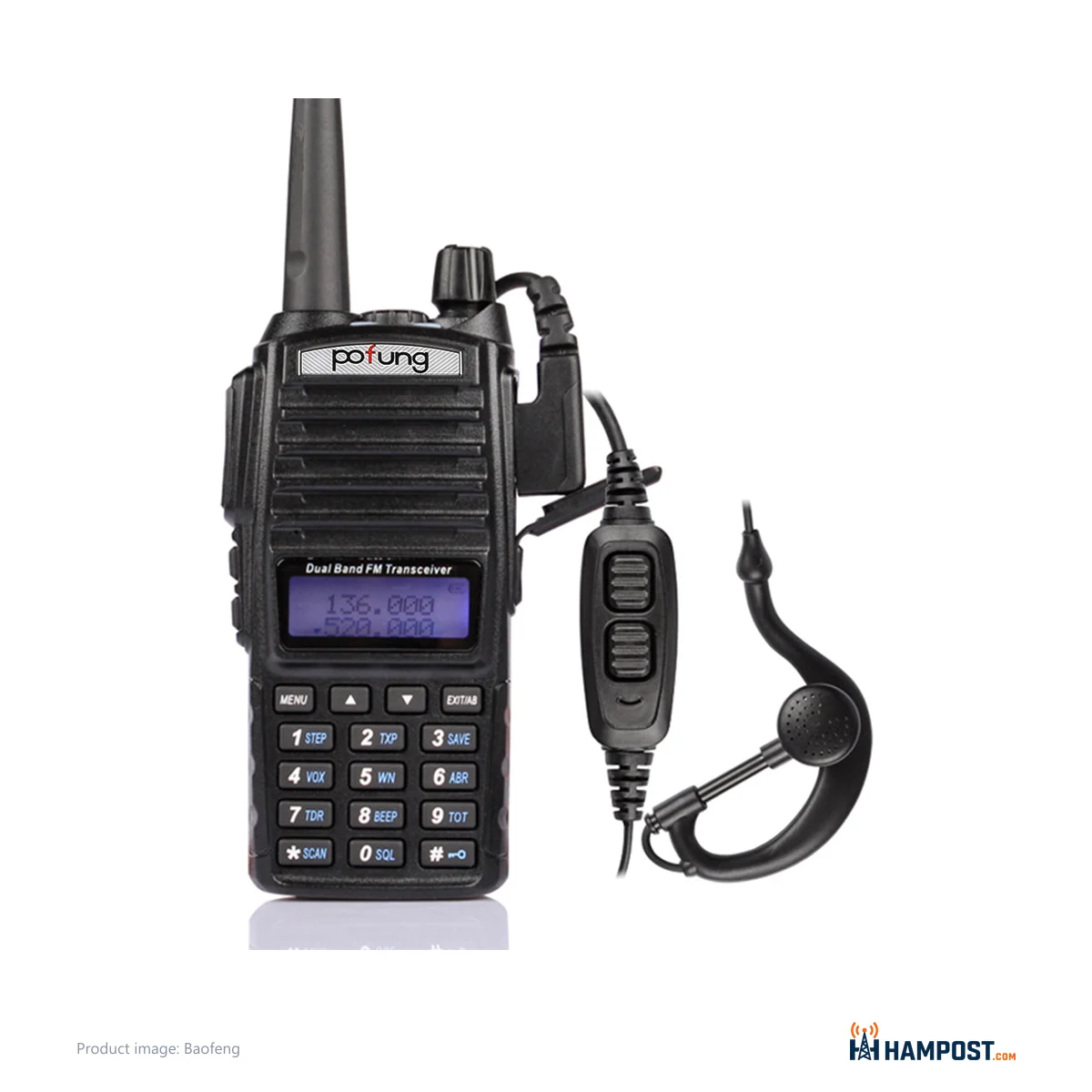
The UV-82 has two talk buttons, and that decides most of what living with it is like. With dual standby on (Menu 7, TDR), press the top of the rocker and you transmit on the A channel, press the bottom and you transmit on B. No swapping the display around first.
The rest of the radio follows from the body. Inside it is the same board family as the UV-5R, but the longer case sits fuller in the hand, feels more solid and drives a louder 1 W speaker. It is still a Baofeng, with a street price around $25 to $55, so I carry it the way I carry a pocket knife: used hard, replaced without tears.
What the bigger body does not change are the Baofeng basics. The keypad is a chore, the receiver gets busy in crowded RF and the transmitter looks bad on a test set. Below is how I run mine around all three.
Two talk buttons, one hand
Dual watch is where the rocker earns its place. I park the local repeater on one channel and a simplex frequency on the other, listen to both, and push up or down to answer whichever one called. On a UV-5R that takes a button press and a glance at the screen. On the UV-82 it is a thumb movement.
Not everyone likes it, and the split is close. The case against is practical. A speaker mic with a single PTT button only keys the lower (B) channel, and with an external mic plugged in the radio can jump to B on its own. Dual-PTT speaker mics exist, but the ones I have seen are limited and poorly made. If you live on a speaker mic, the rocker is a quirk you work around rather than a feature you use.
My workaround is simple: the channel I talk on most goes on B, always. Then the speaker mic, the bottom of the rocker and the radio's habit of falling back to B all point the same way.
The other irritation is mode switching. There is no direct key to go between VFO and memory mode. You power off, hold MENU and power on again. It works, but it is the kind of thing you forget in a hurry, so I set the radio up in memory mode and leave it there.
A case that takes knocks
Pick up a UV-82 after a UV-5R and the difference is obvious. It is longer, the grip fills the hand and the whole thing feels more rugged. I don't baby it. It rides in a go-bag, takes the usual knocks and keeps working.
The hardware is where the build saving shows. The belt-clip screws can back out because there are no lock washers, and the antenna spanner nut can come loose. Neither is a big deal if you check them on day one. I put a lock washer under each clip screw, or a dab of silicone if I don't have washers. I avoid Loctite on the plastic case.
Receive: fine on repeaters, crowded in town
On 2 m and 70 cm repeaters the receiver does its job. With a clear path to a high site, signals come in at full quieting, and range through repeaters is good for a radio in this price bracket. For the kind of use most people buy it for, talking through the local machine and checking in to a net, it is enough.
Push it harder and the weaknesses appear. In a city with strong signals all around, intermod shows up, and pager breakthrough can come through the squelch. Scanning is the other sore spot: the squelch opens on noise while it scans, which makes a long scan list tiresome to listen to.
Here operators disagree about the UV-5R. My view is that the UV-82 receives better: cleaner, louder audio and an easier listen on a busy channel. The other camp says the UV-5R receiver handles squelch and scanning better. I would not buy either one for scanning, so the point matters less to me than the audio does.
Against a Yaesu FT-60R the gap is real. The Yaesu is clearly cleaner on weak signals. If you work fringe repeaters, that is the radio to step up to.
Audio you can hear across the shack
The 1 W speaker is the best thing about this radio after the case. Receive audio is loud and clear, and I can hear the radio across a room or clipped to a belt outdoors without turning it all the way up. It is better than the UV-5R, and to my ear it holds its own against the FT-60R on speaker audio.
Transmit audio is clean too. Signal reports come back clear and natural, with nothing to adjust in the menu to get there.
The transmitter on a test set
This is the part I can't wave away. Put on a service monitor, the transmitter's spurious output is poor, with harmonics and spurs above where they should be. The worst numbers belong to the 220 MHz variants, but the 2 m and 70 cm radios have measured out of spec as well.
On the air, at 5 W into a repeater, it performs as well as handhelds that cost several times more, in my use. The opposing view deserves a hearing anyway: a radio that fails bench specs is not a good teaching tool for a new ham who is supposed to learn what a clean signal is. If I were running it into an outside antenna near other services, I would add a low-pass or bandpass filter.
Battery: an honest 1800 mAh
The pack is 1800 mAh at 7.4 V. Some packs carry a 2800 mAh label, but the real capacity is around 1700 to 1800 mAh, and that is what I plan around. Don't buy a second pack because the number on it looks bigger.
In practice the battery lasts well. Light use goes a long way between charges, and a radio left in the go-bag still holds its charge after months of sitting.
The desktop charger is the weak part of the power story. It feels cheap, and I check that it actually charges the day it arrives rather than the day I need it.
Programming: CHIRP or nothing
Programming from the keypad is a pain, and the printed manual does little to help. I don't do it beyond changing a frequency in the field. Buy a cable and use CHIRP. The same cable and the same image file I use for the UV-5R work on the UV-82.
The cable matters. A genuine FTDI cable is the one to get, because knock-off chips cause driver trouble on Windows that can eat an evening. Firmware is the other trap: radios with unusual firmware may not talk to CHIRP at all, and radios bought from baofengtech.com have been the safe bet for CHIRP-compatible firmware.
When CHIRP refuses to upload, one trick usually gets it through. Download from the radio first, paste your channel data over that downloaded sheet, then upload. CHIRP then writes back a file that matches the radio's own layout.
Check the DTMF 'D' tone if you use it. Early firmware did not send it correctly, and firmware B82S25 is the version said to fix it. I test it on my own radio before trusting it for a link or a remote.
What I changed first
The stock earpiece and hand mic went straight in a box. Both are junk, and the earpiece jack is not the sturdiest part of the radio either. A decent earpiece from a known maker makes more difference than any setting.
The antenna is a closer call, and operators split on it. One side calls the stock antenna weak and swaps it for a Nagoya dual-band or an RH-660S on day one. The other side, slightly larger, finds the stock antenna as good as the ones on other handhelds and gets nothing from a longer whip. My take: run the stock antenna for a week. If repeaters you should reach are scratchy, a good dual-band whip is the cheapest upgrade you will make.
The UV-82 next to its neighbours
| Radio | Why you'd pick it |
|---|---|
| Baofeng UV-82 | Sturdier body, louder speaker and dual PTT on the same Baofeng internals |
| Baofeng UV-5R | Smaller and lighter, one PTT, no rocker quirks with speaker mics |
| Yaesu FT-60R | Clearly cleaner on weak signals and a proper benchmark handheld |
| Baofeng UV-82HP | The higher-power sibling, with the same rocker and menu quirks |
| Wouxun KG-UV series | Another budget Chinese dual-band if you want to try a different maker |
I can't vouch for the UV-82HP's exact output or battery differences, and I can't promise what a new UV-82 costs or how easy it is to find this year. Price it against the UV-5R before you decide.
How I set up a new UV-82
- Get a good programming cable, FTDI if you can, and install CHIRP.
- If CHIRP won't upload, download from the radio first, paste your channels over that file and upload it back.
- Put your main repeater on the lower (B) channel so a single-PTT speaker mic keys the right one.
- Learn the MENU-at-power-on switch between VFO and memory mode before you need it.
- Fit lock washers or a dab of silicone (not Loctite) on the belt-clip screws, and snug the antenna spanner nut.
- Check the firmware if you use DTMF; B82S25 fixes the 'D' tone.
- Try the stock antenna, then swap for a Nagoya dual-band or RH-660S if range is poor.
Who should buy it
- New hams and clubs on a tight budget, provided they buy a cable and use CHIRP.
- Anyone who wants a backup or go-bag radio they won't mind losing.
- Repeater users on 2 m and 70 cm who want to monitor two channels and answer either with one thumb.
- UV-5R owners who want the same programming and a better feel in the hand.
Who should skip it
- Operators in crowded urban RF, where intermod and squelch problems will wear thin.
- Anyone who wants to program from the keypad.
- Anyone who needs a clean transmit spectrum without adding a filter.
- Speaker-mic users who hate the idea of keeping their main channel on B.
Bottom line
The UV-82 is the better-built Baofeng: tougher, louder and easier to hold than a UV-5R, with a dual PTT rocker that makes dual watch genuinely useful once your main channel lives on B. It keeps the family faults, so program it with CHIRP and accept that the transmitter is not clean. As a cheap repeater and go-bag radio, I'd buy it again.
Reader field notes — share yours
Log in to share your field notes and photos.