
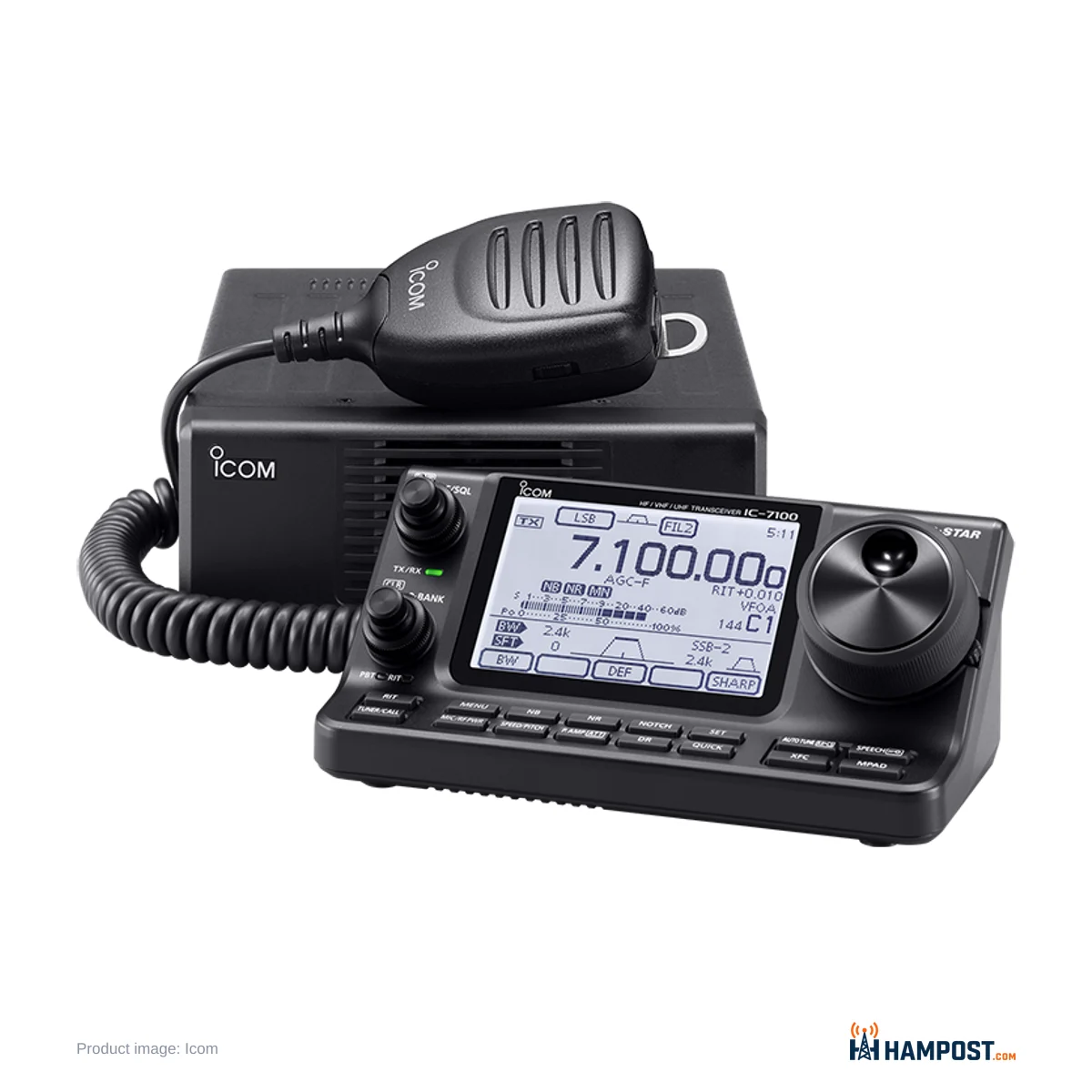
The IC-7100 is a radio you mostly look at through its head. The main unit, a black box with the PA and both antenna jacks, goes under a seat, behind the desk or on a shelf, and everything you touch lives on a small angled controller joined to it by one Ethernet-type cable. That split is the whole reason to buy it, and it shapes almost everything good and bad about owning one.
Inside is a lot of radio for a street price around $840: 100 W on HF and 6 m, 50 W on 2 m, 35 W on 70 cm, every analog mode, D-STAR, a USB port that carries both CAT and audio, and an SD card slot. Icom still lists it, with firmware E6 dated December 2024.
My view: it is still the neatest way to put HF through 70 cm in a car or on a small desk. Just go in knowing that the receiver is good rather than great, the screen is monochrome, and there is no tuner inside.
One cable, one head, anywhere you want it
The controller measures 165 x 64 x 78.5 mm and weighs about 0.5 kg. The main unit is 167 x 58 x 225 mm and 2.3 kg. The head carries the speaker plus the mic, key and phones jacks, so the box can sit wherever the 22 A supply leads and the coax are easiest to run.
The link is ordinary CAT5 or CAT6 patch cable with RJ-45 plugs, which makes long runs easy. I would not hesitate to put the body in a trunk or a closet and run a long patch cable to the head. Home stations use the same trick to keep the box and its supply off the desk. For dash mounts, the Lido and RAM gooseneck style holders are the common answer, and Icom sells the MBF-1 suction base with the MBA-1 bracket. My guide to clean mobile radio installations covers power runs and grounding for exactly this kind of split radio.
One fault comes up often enough to plan for. With the volume high and a strong signal in, the radio can reset or act strangely, and the usual cure is to stop coiling the head cable. Lay the excess flat or cut a patch cable to length and the problem goes away. The same goes for supply voltage: the IC-7100 shuts down when the voltage sags on transmit, so give it heavy leads straight to the battery in a vehicle and a supply that holds 13.8 V at 22 A at home.
Touch screen, menus and the small knobs
The 48.6 x 75.9 mm screen is resistive, which means it needs a firm press and works with gloves on. Tap the frequency and band keys appear. Tap the mode or filter and you change it. For most operators the touch interface makes the menus easy to learn, and the deeper settings sit under the Set screen. A thin screen protector and a stylus make the firm press easier.
The common wish is colour. The display is a monochrome dot-matrix LCD, and after the IC-7300 it looks dated. It is readable in a car, which is what it was drawn for, but it is not pretty.
The knobs are the other weak spot. The stacked concentric controls on the left are small and feel cheaper than the rest of the radio. The main tuning knob is better, and its tension is adjustable, which is worth setting the first day.
How the receiver and the band scope hold up
On the air the receiver is good. Noise blanker and noise reduction both work well, the 32-bit IF DSP gives you twin PBT and adjustable IF filters, and those DSP functions work on every band up to 70 cm. Maker sensitivity on SSB is 0.15 µV on HF and 0.11 µV on 2 m and 70 cm with the preamp on.
It is not a contest receiver, and the numbers say why. The ARRL Lab measured 95 dB of third-order dynamic range at 20 kHz spacing on 14 MHz, but only 68 dB at 2 kHz. In a crowded CW pileup or on a contest weekend that close-in figure shows. For a front end that handles strong neighbours better, the Icom IC-7300 review explains what direct sampling bought Icom three years later.
The band scope is a sweep scope, not a real-time waterfall. It shows you that a band is open and roughly where the activity is, and that is about all. Do not buy the IC-7100 for its scope.
Transmit audio and the low-power SSB question
This is the one subject where operators really disagree. One camp finds average SSB voice output low, with the meter barely reaching half power on speech while CW, FM and digital modes make the full 100 W without trouble. The other camp gets full output and good audio reports and sees no problem at all. Both camps are large.
Icom's own E5 firmware from January 2016 lists "speech compressor function is improved", and that update helped some radios but not all. A hardware mod in the ALC circuit raises average power, but it moves the radio away from its factory ALC design. My view: leave the hardware alone.
What works for most is technique. Set mic gain so the ALC reads in the middle of its zone on voice peaks, then add compression at a moderate level rather than full. With that done, transmit audio reports are good.
The stock HM-198 hand mic is the weak link for many. The optional HM-151 multi-function mic, or a good desk mic, makes a clear difference.
D-STAR, digital modes and the USB port
D-STAR is the feature that sets the IC-7100 apart from most HF mobiles. DR mode makes repeater and hotspot use simple: pick your repeater from the list, set your callsign, press PTT. There is no GPS receiver built in, so the near-repeater search and position reports need an external GPS or a typed-in location. If D-STAR is new to you, start with my comparison of D-STAR, Fusion and DMR digital voice.
For FT8 and the other sound-card modes, one USB cable carries CAT and audio, and there is no interface box to buy. The catch is that SSB-DATA audio defaults to the ACC jack on the rear. Go into Set, then Connectors, and switch the data modulation input to USB before you blame your software. Icom's RS-BA1 software adds remote control over a network, and the split head makes the IC-7100 a natural candidate for the setups in my guide to operating your station remotely.
No tuner inside, and what to add
There is no internal ATU, and plenty of buyers wish there were. For mobile antennas and resonant wires that matters less than it sounds. For anything else, plan on an external tuner. The Icom AH-4 works from the TUNE key, and LDG units built for Icom radios do the same through the tuner port, so tuning stays a one-button job.
Other things worth adding: an SD card from day one (it saves settings, memories and voice recordings and is your backup before any firmware update), an external speaker for home use, and RT Systems or CS-7100 software for programming memories, which beats entering hundreds of channels on the touch screen.
What goes wrong over the years
Most IC-7100s run for years without trouble. The radio runs cool and the fan is quiet, which helps in a closed vehicle. The recurring hardware fault was the touch screen on early production units, where the digitizer stopped responding, and those were repaired under warranty. Firmware E6 from December 2024 is a production change only, with no difference in operation, so a radio on E5 is not missing anything you would use. Before any update, save your data to the SD card or with the cloning software.
If you are buying used, check that every corner of the touch screen responds, check output on SSB voice as well as on CW, and ask which firmware it runs.
Setting it up the first evening
- Update to firmware E5 or later and save a backup to SD card first.
- Set the main dial tension to suit you.
- Set mic gain with the ALC meter on voice peaks, then add moderate compression.
- In Set, Connectors, switch SSB-DATA modulation to USB for digital modes.
- Run heavy DC leads and route the head cable flat, without coils.
- Load your D-STAR callsign and update the repeater list.
- Program memories with software, not on the screen.
How it compares
RadioBands and powerWhy you would pick it Icom IC-7100HF to 70 cm, 100 W HFSeparate head on one patch cable, D-STAR, single USB cable Yaesu FT-991AHF to 70 cm, 100 W HFBuilt-in tuner, colour touch screen and real-time scope in one box Icom IC-7300HF and 6 m, 100 WBetter receiver, real-time waterfall, built-in tuner, no VHF/UHF Yaesu FT-891HF and 6 m, 100 WSmaller, simpler HF mobile with a detachable front panel Icom IC-705HF to 70 cm, 10 WBattery portable with a colour waterfall, at QRP powerThe closest rival is the one-box Yaesu. My Yaesu FT-991A review covers a radio with a tuner and a better screen but no remote head. For HF only in a car, the Yaesu FT-891 mobile HF review is the cheaper path, and for field work on batteries the Icom IC-705 portable QRP review is the better fit.
Who should buy it
- Mobile operators who want HF, 6 m, 2 m and 70 cm from one radio with the box out of sight.
- Small-desk and apartment stations that want the body and supply on a shelf and only the head in front of them.
- D-STAR users who also want HF and digital modes over one USB cable.
- Operators planning a remote setup around a radio with a separate head.
Skip it if you chase weak signals in contests or crowded pileups, if you want a colour waterfall, or if you need a tuner inside the case. A home station that will never leave the desk is better served by one of the radios in my roundup of HF transceivers for the home station.
Bottom line
The IC-7100 is still the tidiest way to put HF through 70 cm and D-STAR in a car or on a small desk, with a head that goes anywhere a patch cable reaches. Its receiver, scope and monochrome screen show their age, and SSB power takes some setup, but at its street price it is still one of the best-value all-band radios you can buy new.
Reader field notes — share yours
Log in to share your field notes and photos.