
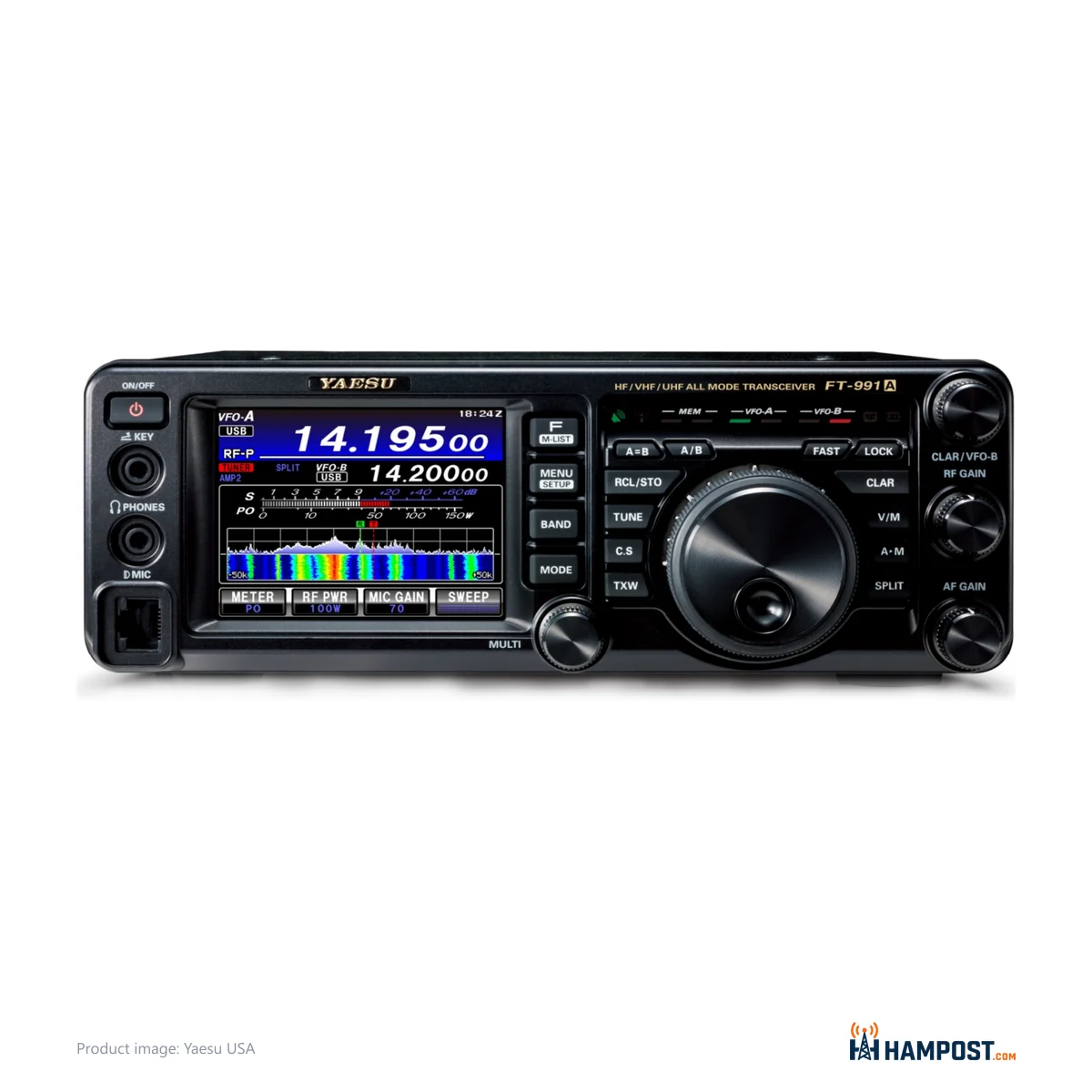
My whole station fits on one corner of a desk. HF from 160 m up, 6 m, 2 m and 70 cm, SSB to C4FM, all from one Yaesu FT-991A and one USB cable to the computer. That is the reason to own this radio, and it is the reason I keep forgiving it for the menus.
It is not the best HF rig I could buy at what it costs now, and it is not the best VHF/UHF rig either. It is the best answer I know to a different question: what do I put on the desk if I only get one box?
Street price around $1,300 to $1,450 new. If you remember it at $1,099 to $1,199, that price is gone, and I could not find a current new listing anywhere near it.
Living with a shack in a box
Day to day, the FT-991A is the radio I turn on without thinking about which radio to turn on. Check into the 2 m net, swing down to 40 m for a ragchew, park on the FT8 watering hole for the evening. No patch cables, no second rig, no interface box.
The front panel is crammed. There is no polite way around that. Squelch has to be assigned to the multi knob, a lot of functions live behind soft keys and the touchscreen, and the VFO and channel dial behavior took me a while to stop fighting. I kept the printed manual next to the radio for longer than I like to admit.
What turned it around was the row of soft keys along the bottom of the screen. Put the functions you reach for constantly on those keys and the radio gets a lot friendlier. Once that is done, I find touch access often quicker than hunting for a button on a busy panel.
Not everyone gets there. This is the most common complaint about the radio by a wide margin, and plenty of operators never warm to the menus at all. If you want a knob for everything, this is the wrong radio.
HF receive and the 3 kHz roofing filter
On HF the receiver is good for the class. Sensitivity is strong, the band sounds quiet, and the 3 kHz roofing filter earns its place on a crowded weekend band. Next to an IC-7300 it holds up well to my ears, and against a TS-590SG it compares favorably. It is a pleasant radio to listen to for an evening.
Noise reduction is where opinions really split. In a noisy city or condo location the DNR and noise blanker can be effective, sometimes better than what I get from an Icom. The other camp finds DNR watery and distorting, calls the DSP of little use on SSB, and hears the noise blanker distort strong stations. I sit closer to the first group for weak-signal listening, but I run DNR low and switch it off the moment a signal is readable.
The contour control and IF notch help. Setting contour to about 450 Hz made for a quiet, comfortable receive on SSB in my setup.
2 m and 70 cm: handy, not a specialist
Having 50 W on 144 MHz and 430 MHz in the same box as the HF rig is the whole point. For local repeaters, simplex and 2 m FT8 it does the job and I am happy with it.
It is not a dedicated V/UHF radio, though. The front end can be overloaded by a strong nearby station, so if you live close to a big local signal, expect to hear it. FM receive audio from the small internal speaker is tinny and cannot be adjusted much. A larger external speaker fixed most of that for me.
If VHF and UHF are your main interest, an IC-9700 is the better tool and does not pretend to cover HF.
Transmit audio is set up, not shipped
The stock transmit audio does not do the radio justice. The parametric equalizer is the difference between flat and punchy, and I would not judge the audio until you have programmed it along with mic gain. After tailoring the EQ, I get good, punchy audio reports on SSB.
Getting there takes some patience, because the audio settings are not obvious. If you run VOX, make a test recording on VOX as well and confirm the EQ is doing what you think it is.
One USB cable for FT8, RTTY and Winlink
This is the feature I use most. A single USB cable carries CAT control and the built-in sound card, so FT8, RTTY and Winlink run without an external interface. Plug it in, load the driver, pick the audio device and rig in the software, done.
Two details matter. On 60 m the band is memory-channelized, so turn off radio control in WSJT-X or the software will fight the radio. And FSK RTTY needs care in the menus: test your keying setup into a dummy load before you go on the air.
C4FM is built in too. For anyone running Fusion through a hotspot or Wires-X, getting that and HF in one radio is a real draw.
What goes wrong
The spectrum scope is the weak spot. It is small and primitive by current standards, less precise than the IC-7300's, and weak signals barely register on it. It tells me where the band activity is. It does not replace a proper panadapter.
The built-in tuner has a narrow range, roughly a 3:1 SWR match. It works well with end-fed wires and a loaded vertical, but it struggles on some 160 m and 80 m loads. Plan on an external tuner or a resonant antenna for the low bands.
At a multi-transmitter Field Day, give it band-pass filters and as much antenna separation as you can. A 100 W rig sitting next to other stations needs that help, and I would not set up a shared site without them.
Long-term: no failures, plenty of menu
Past the 12-month mark my experience is consistent: trouble-free use, no failures, a radio that feels solid and well built. I keep discovering settings I had not touched, which says as much about the menu as about the depth.
Past two years, the menus still annoy me. So does the firmware update procedure, which is clumsy next to Icom's SD card method. Even so, it stays the radio I reach for most, for repeaters, C4FM, FT8 and travel alike.
If you are shopping used, know which version you are looking at. The A version fixed the problems of the original FT-991, so do not judge the FT-991A by stories about the earlier radio, and do not assume an original FT-991 behaves like the A.
Portable: depends how far you carry it
This is another split. For POTA, Field Day or a vacation with a car nearby, it is a fine rig, even with a magnetic loop or a big battery pack. For hiking with a battery, it is a power hog and too large and heavy. I take it where I can drive, and I would pick something smaller for anything on foot.
How it stacks up
| Radio | Why you'd pick it instead |
|---|---|
| Icom IC-7300 | Better scope and interface, but HF and 6 m only |
| Icom IC-9700 | Better VHF/UHF, no HF at all |
| Kenwood TS-590SG | An HF rig with knobs and buttons and a receiver in the same league |
| Kenwood TS-2000 | An older all-band, all-mode rig if you want the same idea on the used market |
| Yaesu FT-991 (original) | Only if it is cheap, since it carries the issues the A version fixed |
For the FT-991A itself, figure on a street price around $1,300 to $1,450 new, or about $1,000 used. On availability: dealers still list it new. I can't vouch for whether Yaesu is still building it, so if a new unit matters to you, ask the dealer before you order.
Setting it up the way I would
- Update to the latest firmware. The 2024 version is the one to run. The procedure is awkward, so read it through once before you start.
- Assign your most-used functions, squelch and filters especially, to the soft keys at the bottom of the screen.
- Program the transmit parametric equalizer and mic gain before you judge your audio.
- Add a larger external speaker for FM. A 600 Hz bass cut and contour near 450 Hz gave me a quieter receive.
- On 60 m digital modes, turn off radio control in the software because the band is memory-channelized.
- For Field Day or any multi-transmitter event, use band-pass filters and separate the antennas widely.
Who should buy it
- Operators with limited space who want HF, 6 m, 2 m and 70 cm all-mode in one box
- Anyone running FT8 and other digital modes who wants a single USB cable and no interface
- C4FM and Wires-X users who also want HF
- Casual HF operators who also work the local repeaters
Who should skip it
- Contesters and DXers who want a large, detailed spectrum scope on the radio
- Anyone who wants a dedicated knob or button for every function
- VHF/UHF specialists, who will be happier with an IC-9700
- Portable operators who carry their station on foot
Bottom line
The FT-991A is the radio for a ham who has room for one box and wants every band from 160 m to 70 cm in it, with digital modes through a single USB cable. The menus and the small scope are real costs, and at around $1,300 to $1,450 it is no longer cheap. I still think it is the best all-in-one shack on a small desk, and it has been dependable.
Reader field notes — share yours
Log in to share your field notes and photos.