
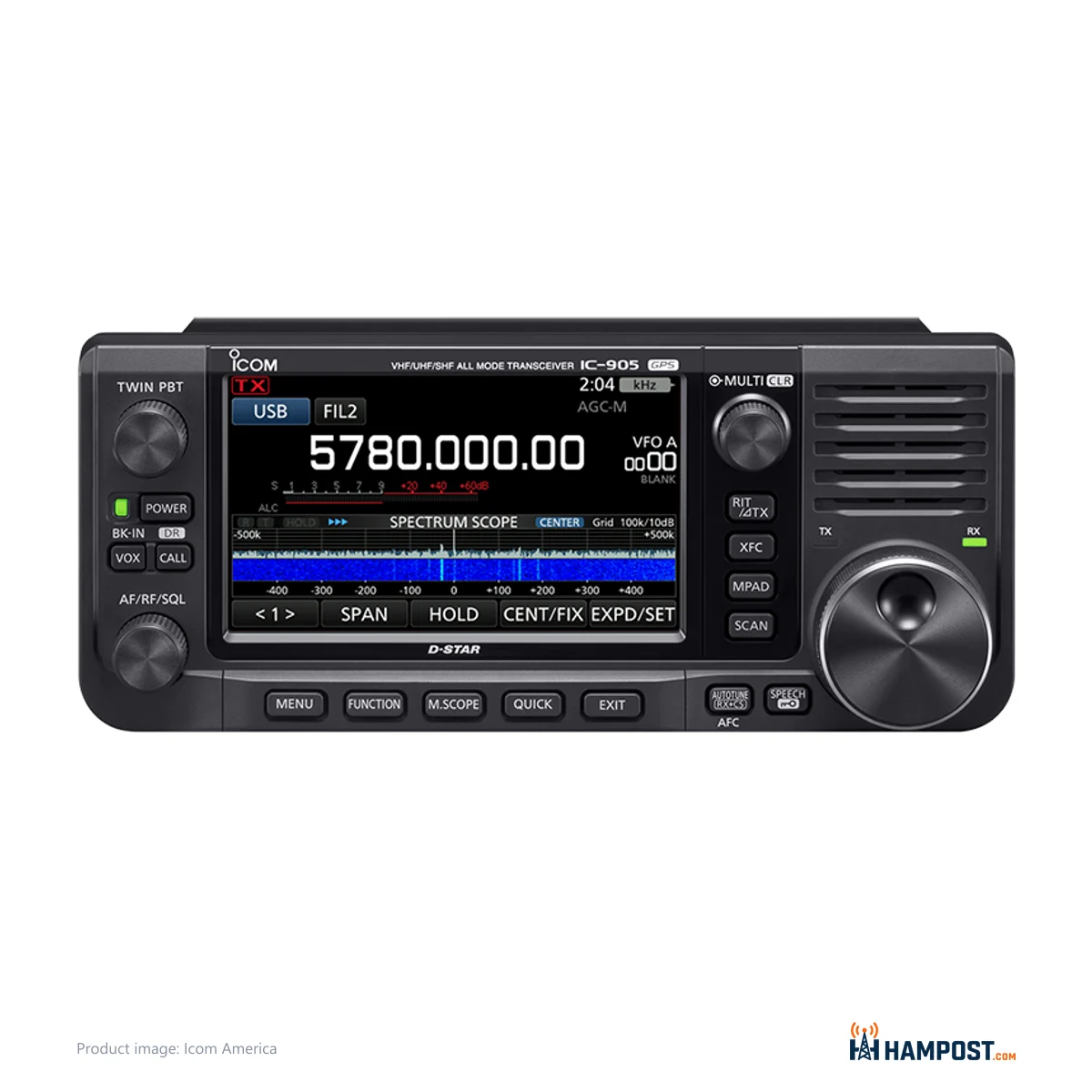
Icom did something nobody expected when they announced the IC-905. They took the bands that most hams ignore (everything above 440 MHz) and put them in a single box with a controller that looks like it belongs in a modern shack instead of a 1990s laboratory.
Street prices in this article were checked in August 2026 and move around; verify with a dealer such as HRO, DX Engineering, or GigaParts before you buy.
I've had the IC-905 on my bench and in the field for several months now. Here's what it does well, where it falls short, and who should actually consider buying one at its significant price point.
What the IC-905 Actually Is
The IC-905 is a VHF/UHF/SHF transceiver covering:
- 144 MHz (2m) — 10W
- 430 MHz (70cm) — 10W
- 1200 MHz (23cm) — 2W
- 2400 MHz (13cm) — 1W
- 5600 MHz (6cm) — 1W
- 10.1 GHz (3cm) — 0.5W (with optional CX-10G module)
The design is split: a compact control head (the RF unit containing receivers and low-power transmitters) connects to the main controller via LAN cable. The RF unit mounts at the antenna location, keeping feedline losses minimal on the microwave bands. This is a smart architectural choice because at 5.6 GHz and above, every foot of coax costs you real signal.
All modes: SSB, CW, FM, AM, DV (D-STAR), and DD (Digital Data). The receiver is direct sampling SDR architecture on 144/430 MHz and superheterodyne on the higher bands.
Build Quality and Physical Design
The controller feels like a premium Icom product. If you've used an IC-7610 or IC-9700, the interface paradigm is familiar — touchscreen with physical knobs for tuning and volume. The screen is responsive and readable in direct sunlight, which matters for portable microwave operations.
The RF unit is compact, about the size of two stacked paperback books, and weather-resistant (IP67 rated when properly sealed). It has N-type connectors for 144/430/1200 MHz and SMA for 2400/5600 MHz. The 10 GHz port on the CX-10G module uses a waveguide flange.
One gripe: the LAN cable between controller and RF unit is limited to 100 meters maximum, and Icom recommends shielded Cat6. For a hilltop operation where you want the RF unit on a mast and the controller in your vehicle, this is fine. For a more complex station setup, it can be limiting.
On-Air Performance
144 and 430 MHz
Let me be direct: if you're buying the IC-905 only for 2m and 70cm, you're making a mistake. At 10W output on these bands, it's less powerful than a mid-range HT. The receiver is competent, with good dynamic range and the typical Icom SDR performance you'd expect from a modern design. But you're paying IC-905 money for IC-9700 performance (minus the IC-9700's 50W on 2m and 75W on 70cm).
These bands are here because Icom knows operators want them for satellite work and as a complete weak-signal package. Fair enough. But manage your expectations.
1200 MHz
23cm is where things get interesting. There are surprisingly few all-mode 1200 MHz radios available. The IC-9700 covers it, some older gear like the IC-1275 exists used, and then... transverters. The IC-905 gives you 2W out on 23cm, which with a good yagi can work contacts out to several hundred kilometers on a decent night.
I parked on 1296.100 MHz SSB on a Saturday evening in late spring and called CQ for about 20 minutes. Worked three stations between 80 and 200 km out. Nothing earth-shattering, but for 2W into a 25-element loop yagi, I was satisfied. The receiver sensitivity on 23cm measured at about -140 dBm MDS, which is respectable.
2400 and 5600 MHz
This is really why the IC-905 exists. Getting on 13cm and 6cm previously meant transverters, surplus commercial gear, or homebrewing. The barrier to entry was high. The IC-905 lowers it dramatically.
At 1W on 2400 MHz with a 1.2m dish, you can work line-of-sight paths of 100+ km in good conditions. On 5600 MHz, the same dish gives you more gain (because it's more wavelengths across), but atmospheric absorption starts becoming a factor, and rain fade is real.
I worked a station 67 km away on 5760 MHz during a microwave activity night. Both of us were running IC-905s with offset dishes. Signals were 5/7 both ways. Honestly? It felt like magic. Two years ago that contact would have required transverter setups costing more than the IC-905 itself.
10 GHz (CX-10G Module)
The optional 10 GHz module adds 3cm capability at 0.5W. This is rainscatter, line-of-sight, and contest territory. The module adds about $1,500 to the system cost and connects directly to the RF unit.
I haven't had extensive time on 10 GHz yet (the CX-10G arrived later than the main unit), but initial tests show the signal is clean and the receiver is usable. 10 GHz propagation is wildly variable — clear air ducting can give you 200+ km paths, or you can struggle to work someone 30 km away on a humid day.
The Satellite Question
The IC-905 works for amateur satellite operations, handling V/U, U/V, and the various L-band and S-band satellites. Full duplex operation is supported. For LEO FM birds, it's overkill. For the QO-100 geostationary satellite (2400 MHz uplink, 10489 MHz downlink), it covers the uplink natively but you'd need an external downlink converter for the 10 GHz receive.
A few operators in Europe and the Middle East are using the IC-905 for QO-100 uplink with good results.
What I Don't Like
Several things bug me about this radio:
Price. The IC-905 with CX-10G runs around $5,500-6,000 street price. Without 10 GHz, it's about $4,000. That's a lot of money. For operators who only want one or two of these bands, a transverter approach might be more cost-effective.
Power output. 10W on VHF/UHF and 1-2W on microwaves means you'll likely want external amplifiers for serious work. Good microwave amplifiers aren't cheap, adding $500-2,000 per band.
No 222 MHz. The 1.25m band is missing. This bugs US operators who are active on 222 MHz. Icom probably excluded it because it's not allocated internationally, but it's still disappointing.
The LAN cable dependency. If the cable gets damaged in the field, your radio is dead. Carry a spare. Seriously.
Fan noise on the RF unit. Under transmit, the cooling fans in the RF unit are audible. Not a problem for contest or casual operation, but worth noting if you're doing sensitive EME receive work nearby.
Who Should Buy This
The IC-905 makes sense for:
- Operators who want to get on microwave bands without building transverter systems
- VHF/UHF contesters who need a portable, integrated package for rover operations
- Satellite enthusiasts, particularly for QO-100
- Anyone fascinated by SHF propagation modes (troposcatter, ducting, rain scatter)
It does NOT make sense as:
- A primary VHF/UHF base station (get an IC-9700 or FT-991A for that)
- An entry-level radio (obviously)
- A radio for operators who won't build antennas for the higher bands
That last point matters. The IC-905 without appropriate microwave antennas is like buying a sports car and only driving it in parking lots. You need dishes, horns, or high-gain yagis to make the upper bands useful.
Comparison to Alternatives
Feature IC-905 IC-9700 Transverter Setup 144/430 MHz 10W 50/75W Depends on IF rig 1200 MHz 2W 10W 1-5W typical 2400 MHz 1W No Homebrew/kit 5600 MHz 1W No Homebrew/kit 10 GHz 0.5W (option) No Homebrew/kit Integration All-in-one 3 bands Separate per band Street Price ~$4,000-6,000 ~$1,800 $500-1500/band Learning Curve Low Low HighFinal Verdict
The IC-905 isn't a radio for everyone. It's not even a radio for most hams. But for the operators it's aimed at — the microwave enthusiasts, the rovers, the propagation experimenters — nothing else on the market does what it does in such an integrated package.
Icom took a risk building a commercial product for a niche within a niche. The execution is solid. The price is high but defensible given what you'd spend assembling equivalent transverter capability band by band. If you've been wanting to explore the bands above 70cm and you'd rather spend money than build time, the IC-905 is the first radio that makes that straightforward.
Reader field notes — share yours
Log in to share your field notes and photos.