
General exam G7: Practical Circuits
All 38 questions in subelement G7. The exam asks 3 of them, one from each group (G7A, G7B, G7C). Answers are hidden until you open them.
G7A
-
G7A01 What is the function of a power supply bleeder resistor?
- It acts as a fuse for excess voltage
- It discharges the filter capacitors when power is removed
- It removes shock hazards from the induction coils
- It eliminates ground loop current
Show answer
B. It discharges the filter capacitors when power is removed
-
G7A02 Which of the following components are used in a power supply filter network?
- Diodes
- Transformers and transducers
- Capacitors and inductors
- All these choices are correct
Show answer
C. Capacitors and inductors
-
G7A03 Which type of rectifier circuit uses two diodes and a center-tapped transformer?
- Full-wave
- Full-wave bridge
- Half-wave
- Synchronous
Show answer
A. Full-wave
-
G7A04 What is characteristic of a half-wave rectifier in a power supply?
- Only one diode is required
- The ripple frequency is twice that of a full-wave rectifier
- More current can be drawn from the half-wave rectifier
- The output voltage is two times the peak input voltage
Show answer
A. Only one diode is required
-
G7A05 What portion of the AC cycle is converted to DC by a half-wave rectifier?
- 90 degrees
- 180 degrees
- 270 degrees
- 360 degrees
Show answer
B. 180 degrees
-
G7A06 What portion of the AC cycle is converted to DC by a full-wave rectifier?
- 90 degrees
- 180 degrees
- 270 degrees
- 360 degrees
Show answer
D. 360 degrees
-
G7A07 What is the output waveform of an unfiltered full-wave rectifier connected to a resistive load?
- A series of DC pulses at twice the frequency of the AC input
- A series of DC pulses at the same frequency as the AC input
- A sine wave at half the frequency of the AC input
- A steady DC voltage
Show answer
A. A series of DC pulses at twice the frequency of the AC input
-
G7A08 Which of the following is characteristic of a switchmode power supply as compared to a linear power supply?
- Faster switching time makes higher output voltage possible
- Fewer circuit components are required
- High-frequency operation allows the use of smaller components
- Inherently more stable
Show answer
C. High-frequency operation allows the use of smaller components
-
G7A09 Which symbol in figure G7-1 represents a field effect transistor?
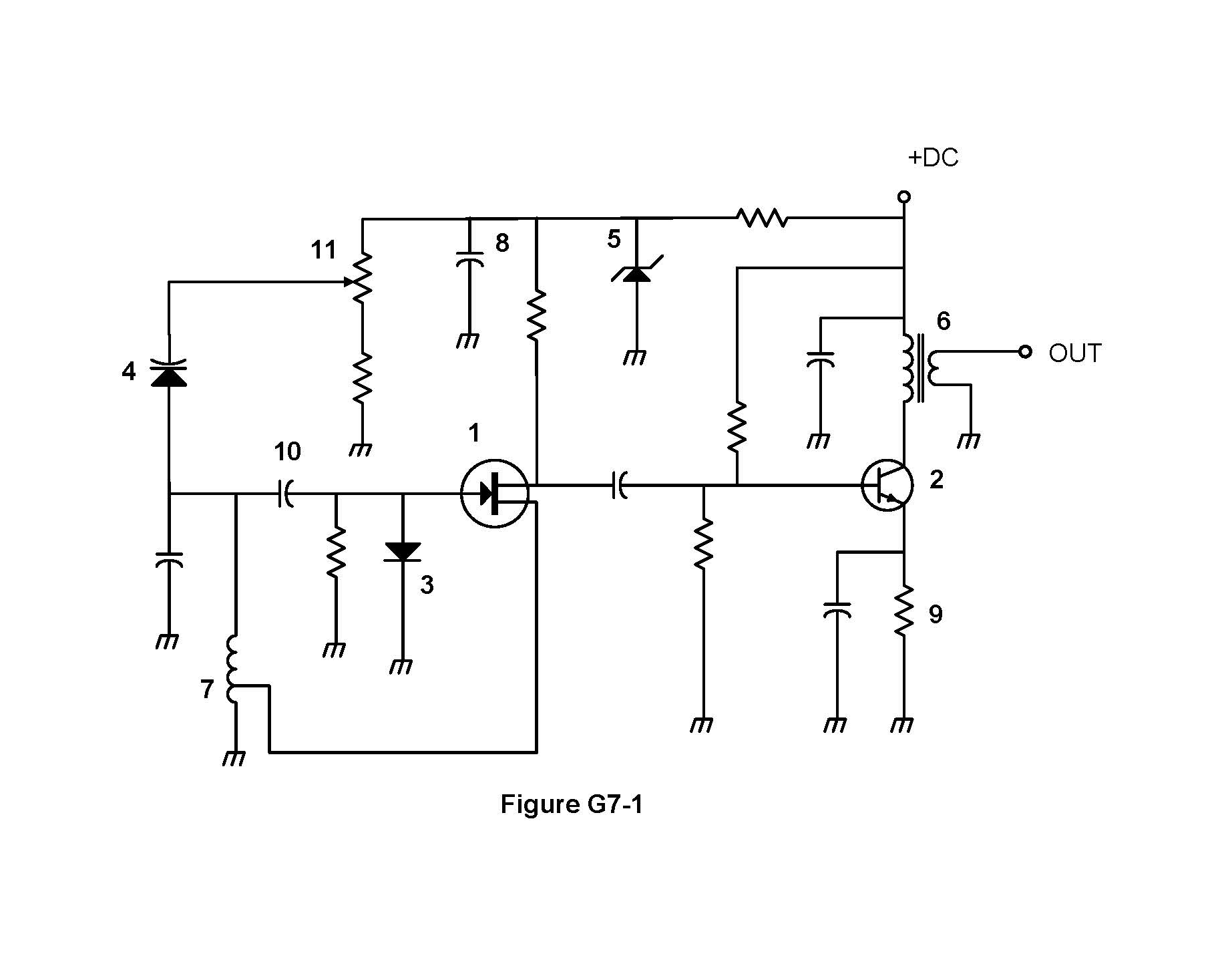
- Symbol 2
- Symbol 5
- Symbol 1
- Symbol 4
Show answer
C. Symbol 1
-
G7A10 Which symbol in figure G7-1 represents a Zener diode?
- Symbol 4
- Symbol 1
- Symbol 11
- Symbol 5
Show answer
D. Symbol 5
-
G7A11 Which symbol in figure G7-1 represents an NPN junction transistor?
- Symbol 1
- Symbol 2
- Symbol 7
- Symbol 11
Show answer
B. Symbol 2
-
G7A12 Which symbol in Figure G7-1 represents a solid core transformer?
- Symbol 4
- Symbol 7
- Symbol 6
- Symbol 1
Show answer
C. Symbol 6
-
G7A13 Which symbol in Figure G7-1 represents a tapped inductor?
- Symbol 7
- Symbol 11
- Symbol 6
- Symbol 1
Show answer
A. Symbol 7
G7B
-
G7B01 What is the purpose of neutralizing an amplifier?
- To limit the modulation index
- To eliminate self-oscillations
- To cut off the final amplifier during standby periods
- To keep the carrier on frequency
Show answer
B. To eliminate self-oscillations
-
G7B02 Which of these classes of amplifiers has the highest efficiency?
- Class A
- Class B
- Class AB
- Class C
Show answer
D. Class C
-
G7B03 Which of the following describes the function of a two-input AND gate?
- Output is high when either or both inputs are low
- Output is high only when both inputs are high
- Output is low when either or both inputs are high
- Output is low only when both inputs are high
Show answer
B. Output is high only when both inputs are high
-
G7B04 In a Class A amplifier, what percentage of the time does the amplifying device conduct?
- 100%
- More than 50% but less than 100%
- 50%
- Less than 50%
Show answer
A. 100%
-
G7B05 How many states does a 3-bit binary counter have?
- 3
- 6
- 8
- 16
Show answer
C. 8
-
G7B06 What is a shift register?
- A clocked array of circuits that passes data in steps along the array
- An array of operational amplifiers used for tri-state arithmetic operations
- A digital mixer
- An analog mixer
Show answer
A. A clocked array of circuits that passes data in steps along the array
-
G7B07 Which of the following are basic components of a sine wave oscillator?
- An amplifier and a divider
- A frequency multiplier and a mixer
- A circulator and a filter operating in a feed-forward loop
- A filter and an amplifier operating in a feedback loop
Show answer
D. A filter and an amplifier operating in a feedback loop
-
G7B08 How is the efficiency of an RF power amplifier determined?
- Divide the DC input power by the DC output power
- Divide the RF output power by the DC input power
- Multiply the RF input power by the reciprocal of the RF output power
- Add the RF input power to the DC output power
Show answer
B. Divide the RF output power by the DC input power
-
G7B09 What determines the frequency of an LC oscillator?
- The number of stages in the counter
- The number of stages in the divider
- The inductance and capacitance in the tank circuit
- The time delay of the lag circuit
Show answer
C. The inductance and capacitance in the tank circuit
-
G7B10 Which of the following describes a linear amplifier?
- Any RF power amplifier used in conjunction with an amateur transceiver
- An amplifier in which the output preserves the input waveform
- A Class C high efficiency amplifier
- An amplifier used as a frequency multiplier
Show answer
B. An amplifier in which the output preserves the input waveform
-
G7B11 For which of the following modes is a Class C power stage appropriate for amplifying a modulated signal?
- SSB
- FM
- AM
- All these choices are correct
Show answer
B. FM
G7C
-
G7C01 What circuit is used to select one of the sidebands from a balanced modulator?
- Carrier oscillator
- Filter
- IF amplifier
- RF amplifier
Show answer
B. Filter
-
G7C02 What output is produced by a balanced modulator?
- Frequency modulated RF
- Audio with equalized frequency response
- Audio extracted from the modulation signal
- Double-sideband modulated RF
Show answer
D. Double-sideband modulated RF
-
G7C03 What is one reason to use an impedance matching transformer at a transmitter output?
- To minimize transmitter power output
- To present the desired impedance to the transmitter and feed line
- To reduce power supply ripple
- To minimize radiation resistance
Show answer
B. To present the desired impedance to the transmitter and feed line
-
G7C04 How is a product detector used?
- Used in test gear to detect spurious mixing products
- Used in a transmitter to perform frequency multiplication
- Used in an FM receiver to filter out unwanted sidebands
- Used in a single sideband receiver to extract the modulated signal
Show answer
D. Used in a single sideband receiver to extract the modulated signal
-
G7C05 Which of the following is characteristic of a direct digital synthesizer (DDS)?
- Extremely narrow tuning range
- Relatively high-power output
- Pure sine wave output
- Variable output frequency with the stability of a crystal oscillator
Show answer
D. Variable output frequency with the stability of a crystal oscillator
-
G7C06 Which of the following is an advantage of a digital signal processing (DSP) filter compared to an analog filter?
- A wide range of filter bandwidths and shapes can be created
- Fewer digital components are required
- Mixing products are greatly reduced
- The DSP filter is much more effective at VHF frequencies
Show answer
A. A wide range of filter bandwidths and shapes can be created
-
G7C07 What term specifies a filter’s attenuation inside its passband?
- Insertion loss
- Return loss
- Q
- Ultimate rejection
Show answer
A. Insertion loss
-
G7C08 Which parameter affects receiver sensitivity?
- Input amplifier gain
- Demodulator stage bandwidth
- Input amplifier noise figure
- All these choices are correct
Show answer
D. All these choices are correct
-
G7C09 What is the phase difference between the I and Q RF signals that software-defined radio (SDR) equipment uses for modulation and demodulation?
- Zero
- 90 degrees
- 180 degrees
- 45 degrees
Show answer
B. 90 degrees
-
G7C10 What is an advantage of using I-Q modulation with software-defined radios (SDRs)?
- The need for high resolution analog-to-digital converters is eliminated
- All types of modulation can be created with appropriate processing
- Minimum detectible signal level is reduced
- Automatic conversion of the signal from digital to analog
Show answer
B. All types of modulation can be created with appropriate processing
-
G7C11 Which of these functions is performed by software in a software-defined radio (SDR)?
- Filtering
- Detection
- Modulation
- All these choices are correct
Show answer
D. All these choices are correct
-
G7C12 What is the frequency above which a low-pass filter’s output power is less than half the input power?
- Notch frequency
- Neper frequency
- Cutoff frequency
- Rolloff frequency
Show answer
C. Cutoff frequency
-
G7C13 What term specifies a filter’s maximum ability to reject signals outside its passband?
- Notch depth
- Rolloff
- Insertion loss
- Ultimate rejection
Show answer
D. Ultimate rejection
-
G7C14 The bandwidth of a band-pass filter is measured between what two frequencies?
- Upper and lower half-power
- Cutoff and rolloff
- Pole and zero
- Image and harmonic
Show answer
A. Upper and lower half-power