
Amateur Extra exam E7: Practical Circuits
All 99 questions in subelement E7. The exam asks 8 of them, one from each group (E7A, E7B, E7C, E7D, E7E, E7F, E7G, E7H). Answers are hidden until you open them.
E7A
-
E7A01 Which circuit is bistable?
- An AND gate
- An OR gate
- A flip-flop
- A bipolar amplifier
Show answer
C. A flip-flop
-
E7A02 What is the function of a decade counter?
- It produces one output pulse for every 10 input pulses
- It decodes a decimal number for display on a seven-segment LED display
- It produces 10 output pulses for every input pulse
- It decodes a binary number for display on a seven-segment LED display
Show answer
A. It produces one output pulse for every 10 input pulses
-
E7A03 Which of the following can divide the frequency of a pulse train by 2?
- An XOR gate
- A flip-flop
- An OR gate
- A multiplexer
Show answer
B. A flip-flop
-
E7A04 How many flip-flops are required to divide a signal frequency by 16?
- 4
- 6
- 8
- 16
Show answer
A. 4
-
E7A05 Which of the following circuits continuously alternates between two states without an external clock signal?
- Monostable multivibrator
- J-K flip-flop
- T flip-flop
- Astable multivibrator
Show answer
D. Astable multivibrator
-
E7A06 What is a characteristic of a monostable multivibrator?
- It switches temporarily to an alternate state for a set time
- It produces a continuous square wave
- It stores one bit of data
- It maintains a constant output voltage, regardless of variations in the input voltage
Show answer
A. It switches temporarily to an alternate state for a set time
-
E7A07 What logical operation does a NAND gate perform?
- It produces a 0 at its output only if all inputs are 0
- It produces a 1 at its output only if all inputs are 1
- It produces a 0 at its output if some but not all inputs are 1
- It produces a 0 at its output only if all inputs are 1
Show answer
D. It produces a 0 at its output only if all inputs are 1
-
E7A08 What logical operation does an OR gate perform?
- It produces a 1 at its output if any input is 1
- It produces a 0 at its output if all inputs are 1
- It produces a 0 at its output if some but not all inputs are 1
- It produces a 1 at its output if all inputs are 0
Show answer
A. It produces a 1 at its output if any input is 1
-
E7A09 What logical operation is performed by a two-input exclusive NOR gate?
- It produces a 0 at its output only if all inputs are 0
- It produces a 1 at its output only if all inputs are 1
- It produces a 0 at its output if one and only one of its inputs is 1
- It produces a 1 at its output if one and only one input is 1
Show answer
C. It produces a 0 at its output if one and only one of its inputs is 1
-
E7A10 What is a truth table?
- A list of inputs and corresponding outputs for an op-amp
- A list of inputs and corresponding outputs for a digital device
- A diagram showing logic states when the digital gate output is true
- A table of logic symbols that indicate the logic states of an op-amp
Show answer
B. A list of inputs and corresponding outputs for a digital device
-
E7A11 What does “positive logic” mean in reference to logic devices?
- The logic devices have high noise immunity
- High voltage represents a 1, low voltage a 0
- The logic circuit is in the “true” condition
- 1s and 0s are defined as different positive voltage levels
Show answer
B. High voltage represents a 1, low voltage a 0
E7B
-
E7B01 For what portion of the signal cycle does each active element in a push-pull, Class AB amplifier conduct?
- More than 180 degrees but less than 360 degrees
- Exactly 180 degrees
- The entire cycle
- Less than 180 degrees
Show answer
A. More than 180 degrees but less than 360 degrees
-
E7B02 What is a Class D amplifier?
- An amplifier that uses switching technology to achieve high efficiency
- A low power amplifier that uses a differential amplifier for improved linearity
- An amplifier that uses drift-mode FETs for high efficiency
- An amplifier biased to be relatively free from distortion
Show answer
A. An amplifier that uses switching technology to achieve high efficiency
-
E7B03 What circuit is required at the output of an RF switching amplifier?
- A filter to remove harmonic content
- A high-pass filter to compensate for low gain at low frequencies
- A matched load resistor to prevent damage by switching transients
- A temperature compensating load resistor to improve linearity
Show answer
A. A filter to remove harmonic content
-
E7B04 What is the operating point of a Class A common emitter amplifier?
- Approximately halfway between saturation and cutoff
- Approximately halfway between the emitter voltage and the base voltage
- At a point where the bias resistor equals the load resistor
- At a point where the load line intersects the zero bias current curve
Show answer
A. Approximately halfway between saturation and cutoff
-
E7B05 What can be done to prevent unwanted oscillations in an RF power amplifier?
- Tune the stage for minimum loading
- Tune both the input and output for maximum power
- Install parasitic suppressors and/or neutralize the stage
- Use a phase inverter in the output filter
Show answer
C. Install parasitic suppressors and/or neutralize the stage
-
E7B06 What is a characteristic of a grounded-grid amplifier?
- High power gain
- Low input impedance
- High electrostatic damage protection
- Low bandwidth
Show answer
B. Low input impedance
-
E7B07 Which of the following is the likely result of using a Class C amplifier to amplify a single-sideband phone signal?
- Reduced intermodulation products
- Increased overall intelligibility
- Reduced third-order intermodulation
- Signal distortion and excessive bandwidth
Show answer
D. Signal distortion and excessive bandwidth
-
E7B08 Why are switching amplifiers more efficient than linear amplifiers?
- Switching amplifiers operate at higher voltages
- The switching device is at saturation or cutoff most of the time
- Linear amplifiers have high gain resulting in higher harmonic content
- Switching amplifiers use push-pull circuits
Show answer
B. The switching device is at saturation or cutoff most of the time
-
E7B09 What is characteristic of an emitter follower (or common collector) amplifier?
- Low input impedance and phase inversion from input to output
- Differential inputs and single output
- Acts as an OR circuit if one input is grounded
- Input and output signals in-phase
Show answer
D. Input and output signals in-phase
-
E7B10 In Figure E7-1, what is the purpose of R1 and R2?
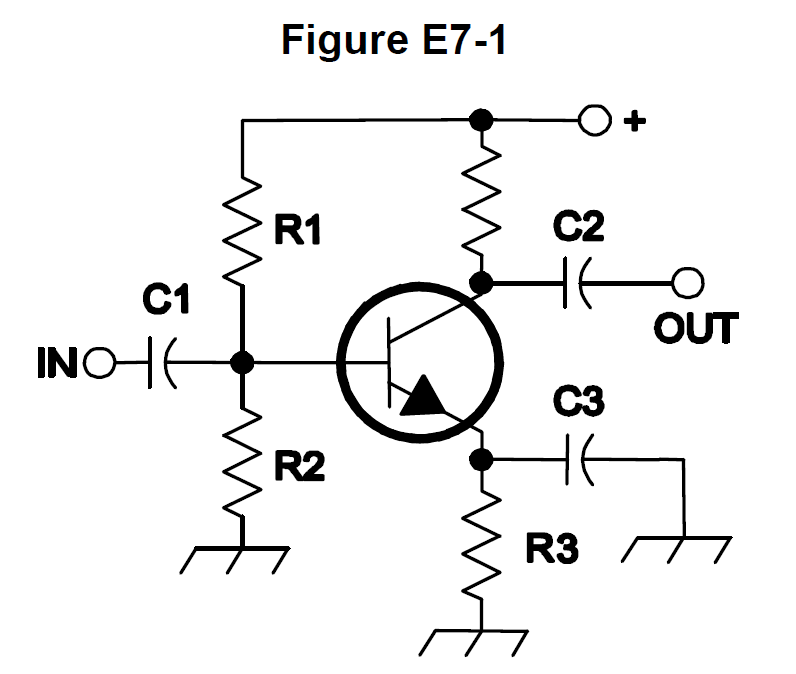
- Load resistors
- Voltage divider bias
- Self bias
- Feedback
Show answer
B. Voltage divider bias
-
E7B11 In Figure E7-1, what is the purpose of R3?
- Fixed bias
- Emitter bypass
- Output load resistor
- Self bias
Show answer
D. Self bias
-
E7B12 What type of amplifier circuit is shown in Figure E7-1?
- Common base
- Common collector
- Common emitter
- Emitter follower
Show answer
C. Common emitter
E7C
-
E7C01 How are the capacitors and inductors of a low-pass filter Pi-network arranged between the network’s input and output?
- Two inductors are in series between the input and output, and a capacitor is connected between the two inductors and ground
- Two capacitors are in series between the input and output, and an inductor is connected between the two capacitors and ground
- An inductor is connected between the input and ground, another inductor is connected between the output and ground, and a capacitor is connected between the input and output
- A capacitor is connected between the input and ground, another capacitor is connected between the output and ground, and an inductor is connected between the input and output
Show answer
D. A capacitor is connected between the input and ground, another capacitor is connected between the output and ground, and an inductor is connected between the input and output
-
E7C02 What is the frequency response of a T-network with series capacitors and a shunt inductor?
- Low-pass
- High-pass
- Band-pass
- Notch
Show answer
B. High-pass
-
E7C03 What is the purpose of adding an inductor to a Pi-network to create a Pi-L-network?
- Greater harmonic suppression
- Higher efficiency
- To eliminate one capacitor
- Greater transformation range
Show answer
A. Greater harmonic suppression
-
E7C04 How does an impedance-matching circuit transform a complex impedance to a resistive impedance?
- It introduces negative resistance to cancel the resistive part of impedance
- It introduces transconductance to cancel the reactive part of impedance
- It cancels the reactive part of the impedance and changes the resistive part to the desired value
- Reactive currents are dissipated in matched resistances
Show answer
C. It cancels the reactive part of the impedance and changes the resistive part to the desired value
-
E7C05 Which filter type has ripple in the passband and a sharp cutoff?
- A Butterworth filter
- An active LC filter
- A passive op-amp filter
- A Chebyshev filter
Show answer
D. A Chebyshev filter
-
E7C06 What are the characteristics of an elliptical filter?
- Gradual passband rolloff with minimal stop-band ripple
- Extremely flat response over its pass band with gradually rounded stop-band corners
- Extremely sharp cutoff with one or more notches in the stop band
- Gradual passband rolloff with extreme stop-band ripple
Show answer
C. Extremely sharp cutoff with one or more notches in the stop band
-
E7C07 Which describes a Pi-L network?
- A Phase Inverter Load network
- A Pi-network with an additional output series inductor
- A network with only three discrete parts
- A matching network in which all components are isolated from ground
Show answer
B. A Pi-network with an additional output series inductor
-
E7C08 Which of the following is most frequently used as a band-pass or notch filter in VHF and UHF transceivers?
- A Sallen-Key filter
- A helical filter
- A swinging choke filter
- A finite impulse response filter
Show answer
B. A helical filter
-
E7C09 What is a crystal lattice filter?
- A power supply filter made with interlaced quartz crystals
- An audio filter made with four quartz crystals that resonate at 1 kHz intervals
- A filter using lattice-shaped quartz crystals for high-Q performance
- A filter for low-level signals made using quartz crystals
Show answer
D. A filter for low-level signals made using quartz crystals
-
E7C10 Which of the following filters is used in a 2-meter band repeater duplexer?
- A crystal filter
- A cavity filter
- A DSP filter
- An L-C filter
Show answer
B. A cavity filter
-
E7C11 Which of the following measures a filter’s ability to reject signals in adjacent channels?
- Passband ripple
- Phase response
- Shape factor
- Noise factor
Show answer
C. Shape factor
E7D
-
E7D01 How does a linear electronic voltage regulator work?
- It has a ramp voltage as its output
- It eliminates the need for a pass transistor
- The control element duty cycle is proportional to the line or load conditions
- The conduction of a control element is varied to maintain a constant output voltage
Show answer
D. The conduction of a control element is varied to maintain a constant output voltage
-
E7D02 How does a switchmode voltage regulator work?
- By alternating the output between positive and negative voltages
- By varying the duty cycle of pulses input to a filter
- By varying the conductivity of a pass element
- By switching between two Zener diode reference voltages
Show answer
B. By varying the duty cycle of pulses input to a filter
-
E7D03 What device is used as a stable voltage reference?
- A Zener diode
- A digital-to-analog converter
- An SCR
- An analog-to-digital converter
Show answer
A. A Zener diode
-
E7D04 Which of the following describes a three-terminal voltage regulator?
- A series current source
- A series regulator
- A shunt regulator
- A shunt current source
Show answer
B. A series regulator
-
E7D05 Which of the following types of linear voltage regulator operates by loading the unregulated voltage source?
- A constant current source
- A series regulator
- A shunt current source
- A shunt regulator
Show answer
D. A shunt regulator
-
E7D06 What is the purpose of Q1 in the circuit shown in Figure E7-2?
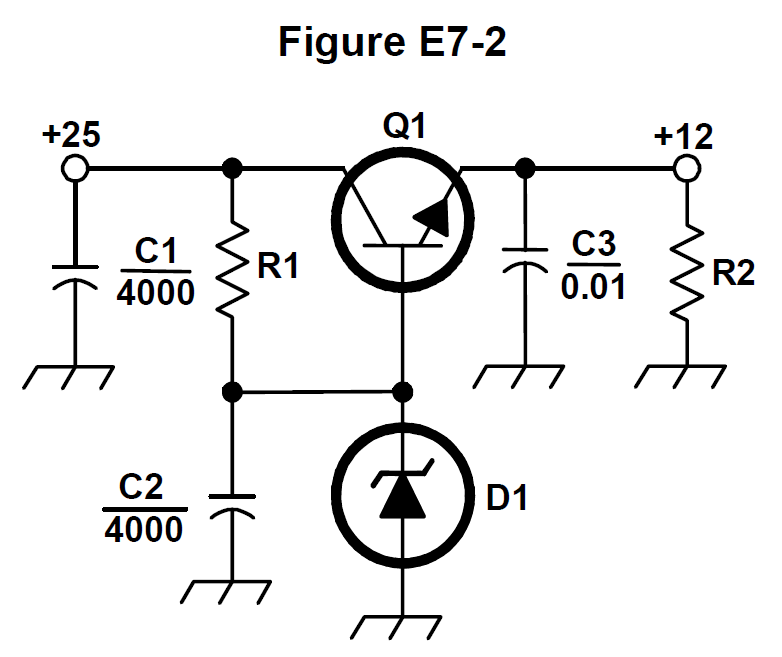
- It provides negative feedback to improve regulation
- It provides a constant load for the voltage source
- It controls the current to keep the output voltage constant
- It provides regulation by switching or “chopping” the input DC voltage
Show answer
C. It controls the current to keep the output voltage constant
-
E7D07 What is the purpose of C2 in the circuit shown in Figure E7-2?
- It bypasses rectifier output ripple around D1
- It is a brute force filter for the output
- To prevent self-oscillation
- To provide fixed DC bias for Q1
Show answer
A. It bypasses rectifier output ripple around D1
-
E7D08 What type of circuit is shown in Figure E7-2?
- Switching voltage regulator
- Common emitter amplifier
- Linear voltage regulator
- Common base amplifier
Show answer
C. Linear voltage regulator
-
E7D09 How is battery operating time calculated?
- Average current divided by capacity in amp-hours
- Average current divided by internal resistance
- Capacity in amp-hours divided by average current
- Internal resistance divided by average current
Show answer
C. Capacity in amp-hours divided by average current
-
E7D10 Why is a switching type power supply less expensive and lighter than an equivalent linear power supply?
- The inverter design does not require an output filter circuit
- The control circuitry uses less current, therefore smaller heat sinks are required
- The high frequency inverter design uses much smaller transformers and filter components for an equivalent power output
- It recovers power from the unused portion of the AC cycle, thus using fewer components
Show answer
C. The high frequency inverter design uses much smaller transformers and filter components for an equivalent power output
-
E7D11 What is the purpose of an inverter connected to a solar panel output?
- Reduce AC ripple on the output
- Maintain voltage with varying illumination levels
- Prevent discharge when panel is not illuminated
- Convert the panel’s output from DC to AC
Show answer
D. Convert the panel’s output from DC to AC
-
E7D12 What is the dropout voltage of a linear voltage regulator?
- Minimum input voltage for rated power dissipation
- Maximum output voltage drop when the input voltage is varied over its specified range
- Minimum input-to-output voltage required to maintain regulation
- Maximum that the output voltage may decrease at rated load
Show answer
C. Minimum input-to-output voltage required to maintain regulation
-
E7D13 Which of the following calculates power dissipated by a series linear voltage regulator?
- Input voltage multiplied by input current
- Input voltage divided by output current
- Voltage difference from input to output multiplied by output current
- Output voltage multiplied by output current
Show answer
C. Voltage difference from input to output multiplied by output current
-
E7D14 What is the purpose of connecting equal-value resistors across power supply filter capacitors connected in series?
- Equalize the voltage across each capacitor
- Discharge the capacitors when voltage is removed
- Provide a minimum load on the supply
- All these choices are correct
Show answer
D. All these choices are correct
-
E7D15 What is the purpose of a step-start circuit in a high-voltage power supply?
- To provide a dual-voltage output for reduced power applications
- To compensate for variations of the incoming line voltage
- To prevent arcing across the input power switch or relay contacts
- To allow the filter capacitors to charge gradually
Show answer
D. To allow the filter capacitors to charge gradually
E7E
-
E7E01 Which of the following can be used to generate FM phone signals?
- Balanced modulation of the audio amplifier
- Reactance modulation of a local oscillator
- Reactance modulation of the final amplifier
- Balanced modulation of a local oscillator
Show answer
B. Reactance modulation of a local oscillator
-
E7E02 What is the function of a reactance modulator?
- Produce PM or FM signals by varying a resistance
- Produce AM signals by varying an inductance
- Produce AM signals by varying a resistance
- Produce PM or FM signals by varying a capacitance
Show answer
D. Produce PM or FM signals by varying a capacitance
-
E7E03 What is a frequency discriminator?
- An FM generator circuit
- A circuit for filtering closely adjacent signals
- An automatic band-switching circuit
- A circuit for detecting FM signals
Show answer
D. A circuit for detecting FM signals
-
E7E04 What is one way to produce a single-sideband phone signal?
- Use a balanced modulator followed by a filter
- Use a reactance modulator followed by a mixer
- Use a loop modulator followed by a mixer
- Use a product detector with a DSB signal
Show answer
A. Use a balanced modulator followed by a filter
-
E7E05 What is added to an FM speech channel to boost the higher audio frequencies?
- A de-emphasis network
- A harmonic enhancer
- A heterodyne enhancer
- A pre-emphasis network
Show answer
D. A pre-emphasis network
-
E7E06 Why is de-emphasis used in FM communications receivers?
- For compatibility with transmitters using phase modulation
- To reduce impulse noise reception
- For higher efficiency
- To remove third-order distortion products
Show answer
A. For compatibility with transmitters using phase modulation
-
E7E07 What is meant by the term “baseband” in radio communications?
- The lowest frequency band that the transmitter or receiver covers
- The frequency range occupied by a message signal prior to modulation
- The unmodulated bandwidth of the transmitted signal
- The basic oscillator frequency in an FM transmitter that is multiplied to increase the deviation and carrier frequency
Show answer
B. The frequency range occupied by a message signal prior to modulation
-
E7E08 What are the principal frequencies that appear at the output of a mixer?
- Two and four times the input frequency
- The square root of the product of input frequencies
- The two input frequencies along with their sum and difference frequencies
- 1.414 and 0.707 times the input frequency
Show answer
C. The two input frequencies along with their sum and difference frequencies
-
E7E09 What occurs when the input signal levels to a mixer are too high?
- Spurious mixer products are generated
- Mixer blanking occurs
- Automatic limiting occurs
- Excessive AGC voltage levels are generated
Show answer
A. Spurious mixer products are generated
-
E7E10 How does a diode envelope detector function?
- By rectification and filtering of RF signals
- By breakdown of the Zener voltage
- By mixing signals with noise in the transition region of the diode
- By sensing the change of reactance in the diode with respect to frequency
Show answer
A. By rectification and filtering of RF signals
-
E7E11 Which type of detector is used for demodulating SSB signals?
- Discriminator
- Phase detector
- Product detector
- Phase comparator
Show answer
C. Product detector
E7F
-
E7F01 What is meant by “direct sampling” in software defined radios?
- Software is converted from source code to object code during operation of the receiver
- I and Q signals are generated by digital processing without the use of RF amplification
- Incoming RF is digitized by an analog-to-digital converter without being mixed with a local oscillator signal
- A switching mixer is used to generate I and Q signals directly from the RF input
Show answer
C. Incoming RF is digitized by an analog-to-digital converter without being mixed with a local oscillator signal
-
E7F02 What kind of digital signal processing audio filter is used to remove unwanted noise from a received SSB signal?
- An adaptive filter
- A crystal-lattice filter
- A Hilbert-transform filter
- A phase-inverting filter
Show answer
A. An adaptive filter
-
E7F03 What type of digital signal processing filter is used to generate an SSB signal?
- An adaptive filter
- A notch filter
- A Hilbert-transform filter
- An elliptical filter
Show answer
C. A Hilbert-transform filter
-
E7F04 Which method generates an SSB signal using digital signal processing?
- Mixing products are converted to voltages and subtracted by adder circuits
- A frequency synthesizer removes unwanted sidebands
- Varying quartz crystal characteristics are emulated in digital form
- Signals are combined in quadrature phase relationship
Show answer
D. Signals are combined in quadrature phase relationship
-
E7F05 How frequently must an analog signal be sampled to be accurately reproduced?
- At least half the rate of the highest frequency component of the signal
- At least twice the rate of the highest frequency component of the signal
- At the same rate as the highest frequency component of the signal
- At four times the rate of the highest frequency component of the signal
Show answer
B. At least twice the rate of the highest frequency component of the signal
-
E7F06 What is the minimum number of bits required to sample a signal with a range of 1 volt at a resolution of 1 millivolt?
- 4 bits
- 6 bits
- 8 bits
- 10 bits
Show answer
D. 10 bits
-
E7F07 What function is performed by a Fast Fourier Transform?
- Converting analog signals to digital form
- Converting digital signals to analog form
- Converting signals from the time domain to the frequency domain
- Converting signals from the frequency domain to the time domain
Show answer
C. Converting signals from the time domain to the frequency domain
-
E7F08 What is the function of decimation?
- Converting data to binary-coded decimal form
- Reducing the effective sample rate by removing samples
- Attenuating the signal
- Removing unnecessary significant digits
Show answer
B. Reducing the effective sample rate by removing samples
-
E7F09 Why is an anti-aliasing filter required in a decimator?
- It removes high-frequency signal components that would otherwise be reproduced as lower frequency components
- It peaks the response of the decimator, improving bandwidth
- It removes low-frequency signal components to eliminate the need for DC restoration
- It notches out the sampling frequency to avoid sampling errors
Show answer
A. It removes high-frequency signal components that would otherwise be reproduced as lower frequency components
-
E7F10 What aspect of receiver analog-to-digital conversion determines the maximum receive bandwidth of a direct-sampling software defined radio (SDR)?
- Sample rate
- Sample width in bits
- Integral non-linearity
- Differential non-linearity
Show answer
A. Sample rate
-
E7F11 What sets the minimum detectable signal level for a direct-sampling software defined receiver in the absence of atmospheric or thermal noise?
- Sample clock phase noise
- Reference voltage level and sample width in bits
- Data storage transfer rate
- Missing codes and jitter
Show answer
B. Reference voltage level and sample width in bits
-
E7F12 Which of the following is generally true of Finite Impulse Response (FIR) filters?
- FIR filters can delay all frequency components of the signal by the same amount
- FIR filters are easier to implement for a given set of passband rolloff requirements
- FIR filters can respond faster to impulses
- All these choices are correct
Show answer
A. FIR filters can delay all frequency components of the signal by the same amount
-
E7F13 What is the function of taps in a digital signal processing filter?
- To reduce excess signal pressure levels
- Provide access for debugging software
- Select the point at which baseband signals are generated
- Provide incremental signal delays for filter algorithms
Show answer
D. Provide incremental signal delays for filter algorithms
-
E7F14 Which of the following would allow a digital signal processing filter to create a sharper filter response?
- Higher data rate
- More taps
- Lower Q
- Double-precision math routines
Show answer
B. More taps
E7G
-
E7G01 What is the typical output impedance of an op-amp?
- Very low
- Very high
- 100 ohms
- 10,000 ohms
Show answer
A. Very low
-
E7G02 What is the frequency response of the circuit in E7-3 if a capacitor is added across the feedback resistor?
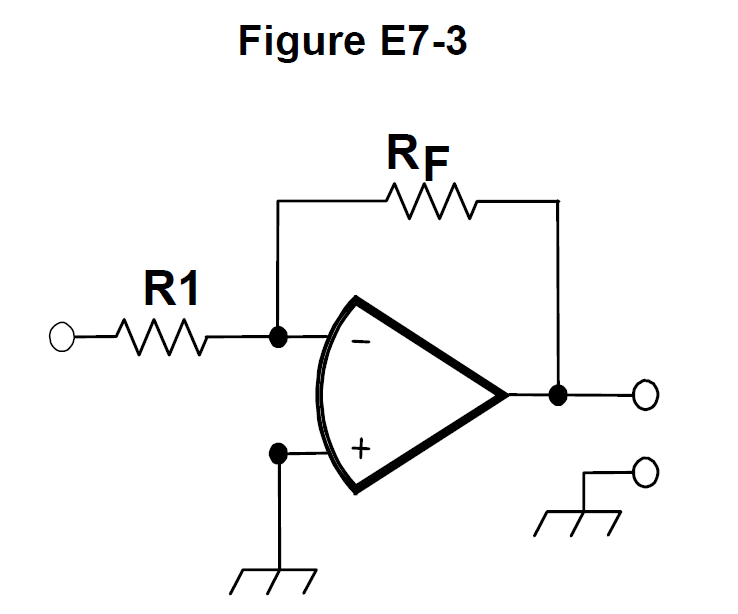
- High-pass filter
- Low-pass filter
- Band-pass filter
- Notch filter
Show answer
B. Low-pass filter
-
E7G03 What is the typical input impedance of an op-amp?
- 100 ohms
- 10,000 ohms
- Very low
- Very high
Show answer
D. Very high
-
E7G04 What is meant by the term “op-amp input offset voltage”?
- The output voltage of the op-amp minus its input voltage
- The difference between the output voltage of the op-amp and the input voltage required in the immediately following stage
- The differential input voltage needed to bring the open loop output voltage to zero
- The potential between the amplifier input terminals of the op-amp in an open loop condition
Show answer
C. The differential input voltage needed to bring the open loop output voltage to zero
-
E7G05 How can unwanted ringing and audio instability be prevented in an op-amp audio filter?
- Restrict both gain and Q
- Restrict gain but increase Q
- Restrict Q but increase gain
- Increase both gain and Q
Show answer
A. Restrict both gain and Q
-
E7G06 What is the gain-bandwidth of an operational amplifier?
- The maximum frequency for a filter circuit using that type of amplifier
- The frequency at which the open-loop gain of the amplifier equals one
- The gain of the amplifier at a filter’s cutoff frequency
- The frequency at which the amplifier’s offset voltage is zero
Show answer
B. The frequency at which the open-loop gain of the amplifier equals one
-
E7G07 What voltage gain can be expected from the circuit in Figure E7-3 when R1 is 10 ohms and RF is 470 ohms?
- 0.21
- 4700
- 47
- 24
Show answer
C. 47
-
E7G08 How does the gain of an ideal operational amplifier vary with frequency?
- It increases linearly with increasing frequency
- It decreases linearly with increasing frequency
- It decreases logarithmically with increasing frequency
- It does not vary with frequency
Show answer
D. It does not vary with frequency
-
E7G09 What will be the output voltage of the circuit shown in Figure E7-3 if R1 is 1,000 ohms, RF is 10,000 ohms, and 0.23 volts DC is applied to the input?
- 0.23 volts
- 2.3 volts
- -0.23 volts
- -2.3 volts
Show answer
D. -2.3 volts
-
E7G10 What absolute voltage gain can be expected from the circuit in Figure E7-3 when R1 is 1,800 ohms and RF is 68 kilohms?
- 1
- 0.03
- 38
- 76
Show answer
C. 38
-
E7G11 What absolute voltage gain can be expected from the circuit in Figure E7-3 when R1 is 3,300 ohms and RF is 47 kilohms?
- 28
- 14
- 7
- 0.07
Show answer
B. 14
-
E7G12 What is an operational amplifier?
- A high-gain, direct-coupled differential amplifier with very high input impedance and very low output impedance
- A digital audio amplifier whose characteristics are determined by components external to the amplifier
- An amplifier used to increase the average output of frequency modulated amateur signals to the legal limit
- A RF amplifier used in the UHF and microwave regions
Show answer
A. A high-gain, direct-coupled differential amplifier with very high input impedance and very low output impedance
E7H
-
E7H01 What are three common oscillator circuits?
- Taft, Pierce, and negative feedback
- Pierce, Fenner, and Beane
- Taft, Hartley, and Pierce
- Colpitts, Hartley, and Pierce
Show answer
D. Colpitts, Hartley, and Pierce
-
E7H02 What is a microphonic?
- An IC used for amplifying microphone signals
- Distortion caused by RF pickup on the microphone cable
- Changes in oscillator frequency caused by mechanical vibration
- Excess loading of the microphone by an oscillator
Show answer
C. Changes in oscillator frequency caused by mechanical vibration
-
E7H03 What is a phase-locked loop?
- An electronic servo loop consisting of a ratio detector, reactance modulator, and voltage-controlled oscillator
- An electronic circuit also known as a monostable multivibrator
- An electronic servo loop consisting of a phase detector, a low-pass filter, a voltage-controlled oscillator, and a stable reference oscillator
- An electronic circuit consisting of a precision push-pull amplifier with a differential phase input
Show answer
C. An electronic servo loop consisting of a phase detector, a low-pass filter, a voltage-controlled oscillator, and a stable reference oscillator
-
E7H04 How is positive feedback supplied in a Colpitts oscillator?
- Through a tapped coil
- Through link coupling
- Through a capacitive divider
- Through a neutralizing capacitor
Show answer
C. Through a capacitive divider
-
E7H05 How is positive feedback supplied in a Pierce oscillator?
- Through a tapped coil
- Through link coupling
- Through a neutralizing capacitor
- Through a quartz crystal
Show answer
D. Through a quartz crystal
-
E7H06 Which of these functions can be performed by a phase-locked loop?
- Wide-band AF and RF power amplification
- Frequency synthesis and FM demodulation
- Photovoltaic conversion and optical coupling
- Comparison of two digital input signals and digital pulse counting
Show answer
B. Frequency synthesis and FM demodulation
-
E7H07 How can an oscillator’s microphonic responses be reduced?
- Use NP0 capacitors
- Reduce noise on the oscillator’s power supply
- Increase the gain
- Mechanically isolate the oscillator circuitry from its enclosure
Show answer
D. Mechanically isolate the oscillator circuitry from its enclosure
-
E7H08 Which of the following components can be used to reduce thermal drift in crystal oscillators?
- NP0 capacitors
- Toroidal inductors
- Wirewound resistors
- Non-inductive resistors
Show answer
A. NP0 capacitors
-
E7H09 What type of frequency synthesizer circuit uses a phase accumulator, lookup table, digital-to-analog converter, and a low-pass anti-alias filter?
- A direct digital synthesizer
- A hybrid synthesizer
- A phase-locked loop synthesizer
- A direct conversion synthesizer
Show answer
A. A direct digital synthesizer
-
E7H10 What information is contained in the lookup table of a direct digital synthesizer (DDS)?
- The phase relationship between a reference oscillator and the output waveform
- Amplitude values that represent the desired waveform
- The phase relationship between a voltage-controlled oscillator and the output waveform
- Frequently used receiver and transmitter frequencies
Show answer
B. Amplitude values that represent the desired waveform
-
E7H11 What are the major spectral impurity components of direct digital synthesizers?
- Broadband noise
- Digital conversion noise
- Spurious signals at discrete frequencies
- Harmonics of the local oscillator
Show answer
C. Spurious signals at discrete frequencies
-
E7H12 Which of the following ensures that a crystal oscillator operates on the frequency specified by the crystal manufacturer?
- Provide the crystal with a specified parallel inductance
- Provide the crystal with a specified parallel capacitance
- Bias the crystal at a specified voltage
- Bias the crystal at a specified current
Show answer
B. Provide the crystal with a specified parallel capacitance
-
E7H13 Which of the following is a technique for providing highly accurate and stable oscillators needed for microwave transmission and reception?
- Use a GPS signal reference
- Use a rubidium stabilized reference oscillator
- Use a temperature-controlled high Q dielectric resonator
- All these choices are correct
Show answer
D. All these choices are correct