
Amateur Extra exam E5: Electrical Principles
All 49 questions in subelement E5. The exam asks 4 of them, one from each group (E5A, E5B, E5C, E5D). Answers are hidden until you open them.
E5A
-
E5A01 What can cause the voltage across reactances in a series RLC circuit to be higher than the voltage applied to the entire circuit?
- Resonance
- Capacitance
- Low quality factor (Q)
- Resistance
Show answer
A. Resonance
-
E5A02 What is the resonant frequency of an RLC circuit if R is 22 ohms, L is 50 microhenries, and C is 40 picofarads?
- 44.72 MHz
- 22.36 MHz
- 3.56 MHz
- 1.78 MHz
Show answer
C. 3.56 MHz
-
E5A03 What is the magnitude of the impedance of a series RLC circuit at resonance?
- High, compared to the circuit resistance
- Approximately equal to capacitive reactance
- Approximately equal to inductive reactance
- Approximately equal to circuit resistance
Show answer
D. Approximately equal to circuit resistance
-
E5A04 What is the magnitude of the impedance of a parallel RLC circuit at resonance?
- Approximately equal to circuit resistance
- Approximately equal to inductive reactance
- Low compared to the circuit resistance
- High compared to the circuit resistance
Show answer
A. Approximately equal to circuit resistance
-
E5A05 What is the result of increasing the Q of an impedance-matching circuit?
- Matching bandwidth is decreased
- Matching bandwidth is increased
- Losses increase
- Harmonics increase
Show answer
A. Matching bandwidth is decreased
-
E5A06 What is the magnitude of the circulating current within the components of a parallel LC circuit at resonance?
- It is at a minimum
- It is at a maximum
- It equals 1 divided by the quantity 2 times pi, times the square root of (inductance L multiplied by capacitance C)
- It equals 2 times pi, times the square root of (inductance L multiplied by capacitance C)
Show answer
B. It is at a maximum
-
E5A07 What is the magnitude of the current at the input of a parallel RLC circuit at resonance?
- Minimum
- Maximum
- R/L
- L/R
Show answer
A. Minimum
-
E5A08 What is the phase relationship between the current through and the voltage across a series resonant circuit at resonance?
- The voltage leads the current by 90 degrees
- The current leads the voltage by 90 degrees
- The voltage and current are in phase
- The voltage and current are 180 degrees out of phase
Show answer
C. The voltage and current are in phase
-
E5A09 How is the Q of an RLC parallel resonant circuit calculated?
- Reactance of either the inductance or capacitance divided by the resistance
- Reactance of either the inductance or capacitance multiplied by the resistance
- Resistance divided by the reactance of either the inductance or capacitance
- Reactance of the inductance multiplied by the reactance of the capacitance
Show answer
C. Resistance divided by the reactance of either the inductance or capacitance
-
E5A10 What is the resonant frequency of an RLC circuit if R is 33 ohms, L is 50 microhenries, and C is 10 picofarads?
- 7.12 MHz
- 23.5 kHz
- 7.12 kHz
- 23.5 MHz
Show answer
A. 7.12 MHz
-
E5A11 What is the half-power bandwidth of a resonant circuit that has a resonant frequency of 7.1 MHz and a Q of 150?
- 157.8 Hz
- 315.6 Hz
- 47.3 kHz
- 23.67 kHz
Show answer
C. 47.3 kHz
-
E5A12 What is the half-power bandwidth of a resonant circuit that has a resonant frequency of 3.7 MHz and a Q of 118?
- 436.6 kHz
- 218.3 kHz
- 31.4 kHz
- 15.7 kHz
Show answer
C. 31.4 kHz
-
E5A13 What is an effect of increasing Q in a series resonant circuit?
- Fewer components are needed for the same performance
- Parasitic effects are minimized
- Internal voltages increase
- Phase shift can become uncontrolled
Show answer
C. Internal voltages increase
E5B
-
E5B01 What is the term for the time required for the capacitor in an RC circuit to be charged to 63.2% of the applied voltage or to discharge to 36.8% of its initial voltage?
- An exponential rate of one
- One time constant
- One exponential period
- A time factor of one
Show answer
B. One time constant
-
E5B02 What letter is commonly used to represent susceptance?
- G
- X
- Y
- B
Show answer
D. B
-
E5B03 How is impedance in polar form converted to an equivalent admittance?
- Take the reciprocal of the angle and change the sign of the magnitude
- Take the reciprocal of the magnitude and change the sign of the angle
- Take the square root of the magnitude and add 180 degrees to the angle
- Square the magnitude and subtract 90 degrees from the angle
Show answer
B. Take the reciprocal of the magnitude and change the sign of the angle
-
E5B04 What is the time constant of a circuit having two 220-microfarad capacitors and two 1-megohm resistors, all in parallel?
- 55 seconds
- 110 seconds
- 440 seconds
- 220 seconds
Show answer
D. 220 seconds
-
E5B05 What is the effect on the magnitude of pure reactance when it is converted to susceptance?
- It is unchanged
- The sign is reversed
- It is shifted by 90 degrees
- It is replaced by its reciprocal
Show answer
D. It is replaced by its reciprocal
-
E5B06 What is susceptance?
- The magnetic impedance of a circuit
- The ratio of magnetic field to electric field
- The imaginary part of admittance
- A measure of the efficiency of a transformer
Show answer
C. The imaginary part of admittance
-
E5B07 What is the phase angle between the voltage across and the current through a series RLC circuit if XC is 500 ohms, R is 1 kilohm, and XL is 250 ohms?
- 68.2 degrees with the voltage leading the current
- 14.0 degrees with the voltage leading the current
- 14.0 degrees with the voltage lagging the current
- 68.2 degrees with the voltage lagging the current
Show answer
C. 14.0 degrees with the voltage lagging the current
-
E5B08 What is the phase angle between the voltage across and the current through a series RLC circuit if XC is 300 ohms, R is 100 ohms, and XL is 100 ohms?
- 63 degrees with the voltage lagging the current
- 63 degrees with the voltage leading the current
- 27 degrees with the voltage leading the current
- 27 degrees with the voltage lagging the current
Show answer
A. 63 degrees with the voltage lagging the current
-
E5B09 What is the relationship between the AC current through a capacitor and the voltage across a capacitor?
- Voltage and current are in phase
- Voltage and current are 180 degrees out of phase
- Voltage leads current by 90 degrees
- Current leads voltage by 90 degrees
Show answer
D. Current leads voltage by 90 degrees
-
E5B10 What is the relationship between the AC current through an inductor and the voltage across an inductor?
- Voltage leads current by 90 degrees
- Current leads voltage by 90 degrees
- Voltage and current are 180 degrees out of phase
- Voltage and current are in phase
Show answer
A. Voltage leads current by 90 degrees
-
E5B11 What is the phase angle between the voltage across and the current through a series RLC circuit if XC is 25 ohms, R is 100 ohms, and XL is 75 ohms?
- 27 degrees with the voltage lagging the current
- 27 degrees with the voltage leading the current
- 63 degrees with the voltage lagging the current
- 63 degrees with the voltage leading the current
Show answer
B. 27 degrees with the voltage leading the current
-
E5B12 What is admittance?
- The inverse of impedance
- The term for the gain of a field effect transistor
- The inverse of reactance
- The term for the on-impedance of a field effect transistor
Show answer
A. The inverse of impedance
E5C
-
E5C01 Which of the following represents pure capacitive reactance of 100 ohms in rectangular notation?
- 0 - j100
- 0 + j100
- 100 - j0
- 100 + j0
Show answer
A. 0 - j100
-
E5C02 How are impedances described in polar coordinates?
- By X and R values
- By real and imaginary parts
- By magnitude and phase angle
- By Y and G values
Show answer
C. By magnitude and phase angle
-
E5C03 Which of the following represents a pure inductive reactance in polar coordinates?
- A positive 45 degree phase angle
- A negative 45 degree phase angle
- A positive 90 degree phase angle
- A negative 90 degree phase angle
Show answer
C. A positive 90 degree phase angle
-
E5C04 What type of Y-axis scale is most often used for graphs of circuit frequency response?
- Linear
- Scatter
- Random
- Logarithmic
Show answer
D. Logarithmic
-
E5C05 What kind of diagram is used to show the phase relationship between impedances at a given frequency?
- Venn diagram
- Near field diagram
- Phasor diagram
- Far field diagram
Show answer
C. Phasor diagram
-
E5C06 What does the impedance 50 - j25 ohms represent?
- 50 ohms resistance in series with 25 ohms inductive reactance
- 50 ohms resistance in series with 25 ohms capacitive reactance
- 25 ohms resistance in series with 50 ohms inductive reactance
- 25 ohms resistance in series with 50 ohms capacitive reactance
Show answer
B. 50 ohms resistance in series with 25 ohms capacitive reactance
-
E5C07 Where is the impedance of a pure resistance plotted on rectangular coordinates?
- On the vertical axis
- On a line through the origin, slanted at 45 degrees
- On a horizontal line, offset vertically above the horizontal axis
- On the horizontal axis
Show answer
D. On the horizontal axis
-
E5C08 What coordinate system is often used to display the phase angle of a circuit containing resistance, inductive, and/or capacitive reactance?
- Maidenhead grid
- Faraday grid
- Elliptical coordinates
- Polar coordinates
Show answer
D. Polar coordinates
-
E5C09 When using rectangular coordinates to graph the impedance of a circuit, what do the axes represent?
- The X axis represents the resistive component, and the Y axis represents the reactive component
- The X axis represents the reactive component, and the Y axis represents the resistive component
- The X axis represents the phase angle, and the Y axis represents the magnitude
- The X axis represents the magnitude, and the Y axis represents the phase angle
Show answer
A. The X axis represents the resistive component, and the Y axis represents the reactive component
-
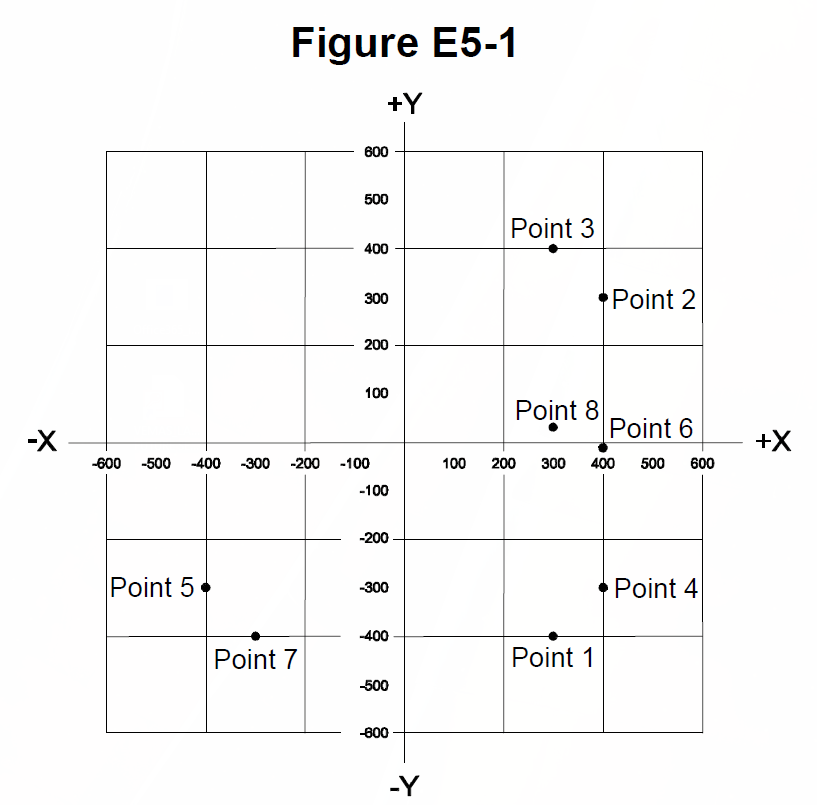
E5C10 Which point on Figure E5-1 best represents the impedance of a series circuit consisting of a 400-ohm resistor and a 38-picofarad capacitor at 14 MHz?
- Point 2
- Point 4
- Point 5
- Point 6
Show answer
B. Point 4
-
E5C11 Which point in Figure E5-1 best represents the impedance of a series circuit consisting of a 300-ohm resistor and an 18-microhenry inductor at 3.505 MHz?
- Point 1
- Point 3
- Point 7
- Point 8
Show answer
B. Point 3
-
E5C12 Which point on Figure E5-1 best represents the impedance of a series circuit consisting of a 300-ohm resistor and a 19-picofarad capacitor at 21.200 MHz?
- Point 1
- Point 3
- Point 7
- Point 8
Show answer
A. Point 1
E5D
-
E5D01 What is the result of conductor skin effect?
- Resistance increases as frequency increases because RF current flows closer to the surface
- Resistance decreases as frequency increases because electron mobility increases
- Resistance increases as temperature increases because of the change in thermal coefficient
- Resistance decreases as temperature increases because of the change in thermal coefficient
Show answer
A. Resistance increases as frequency increases because RF current flows closer to the surface
-
E5D02 Why is it important to keep lead lengths short for components used in circuits for VHF and above?
- To increase the thermal time constant
- To minimize inductive reactance
- To maintain component lifetime
- All these choices are correct
Show answer
B. To minimize inductive reactance
-
E5D03 What is the phase relationship between current and voltage for reactive power?
- They are out of phase
- They are in phase
- They are 90 degrees out of phase
- They are 45 degrees out of phase
Show answer
C. They are 90 degrees out of phase
-
E5D04 Why are short connections used at microwave frequencies?
- To increase neutralizing resistance
- To reduce phase shift along the connection
- To increase compensating capacitance
- To reduce noise figure
Show answer
B. To reduce phase shift along the connection
-
E5D05 What parasitic characteristic causes electrolytic capacitors to be unsuitable for use at RF?
- Skin effect
- Shunt capacitance
- Inductance
- Dielectric leakage
Show answer
C. Inductance
-
E5D06 What parasitic characteristic creates an inductor’s self-resonance?
- Skin effect
- Dielectric loss
- Coupling
- Inter-turn capacitance
Show answer
D. Inter-turn capacitance
-
E5D07 What combines to create the self-resonance of a component?
- The component’s resistance and reactance
- The component’s nominal and parasitic reactance
- The component’s inductance and capacitance
- The component’s electrical length and impedance
Show answer
B. The component’s nominal and parasitic reactance
-
E5D08 What is the primary cause of loss in film capacitors at RF?
- Inductance
- Dielectric loss
- Self-discharge
- Skin effect
Show answer
D. Skin effect
-
E5D09 What happens to reactive power in ideal inductors and capacitors?
- It is dissipated as heat in the circuit
- Energy is stored in magnetic or electric fields, but power is not dissipated
- It is canceled by Coulomb forces in the capacitor and inductor
- It is dissipated in the formation of inductive and capacitive fields
Show answer
B. Energy is stored in magnetic or electric fields, but power is not dissipated
-
E5D10 As a conductor’s diameter increases, what is the effect on its electrical length?
- Thickness has no effect on electrical length
- It varies randomly
- It decreases
- It increases
Show answer
D. It increases
-
E5D11 How much real power is consumed in a circuit consisting of a 100-ohm resistor in series with a 100-ohm inductive reactance drawing 1 ampere?
- 70.7 watts
- 100 watts
- 141.4 watts
- 200 watts
Show answer
B. 100 watts
-
E5D12 What is reactive power?
- Power consumed in circuit Q
- Power consumed by an inductor’s wire resistance
- The power consumed in inductors and capacitors
- Wattless, nonproductive power
Show answer
D. Wattless, nonproductive power